











general news issue 61
Fast buy this issue with Paypal
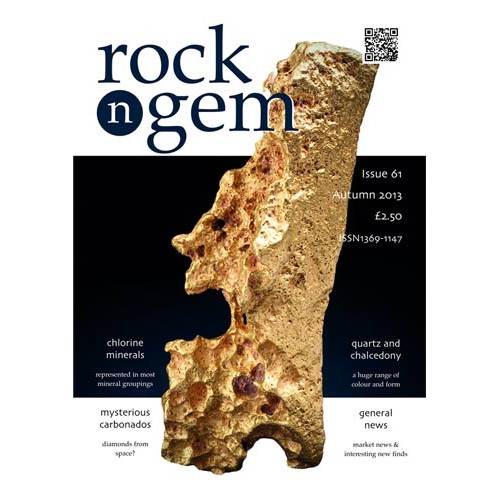
general crystal, mineral news from issue 61
same time next year!
If you missed the Perseid meteor shower in August, not to worry just keep an eye out next year!
should we be concerned?
NASA has brought a Wide-field Infrared Survey Explorer telescope out of storage to join the hunt for asteroids that maybe heading our way…
I'm sure we all remember the Russian meteorite in February, but did you know that the energy released as it hit the atmosphere was equivalent to 30 x the Hiroshima atom bomb and that hundreds of tons of dust still remain in the atmosphere.
Researchers discovered that they could track the dust plume by satellite. On average 30 tonnes of space dust lands each day!
more from orkney
Another inscribed stone has been discovered at the Ness of Brodgar, Orkney Isles Scotland, apparently this one has finer detail and has been described as 'a complex piece of art'.
floating diamonds?
Well, University of Rochester researchers have managed to levitate a diamond with a laser, only a small one but they did it which shows how light exerts force on objects.
Dominating the diamond supply market are countries such as South Africa, Canada and Russia however geologists are certain that parts of Southeast India have the correct properties to yield large quantities of diamonds as well. Interestingly the geologists stumbled upon this conclusion whilst exploring for other minerals.
on the market
Haven't yet heard how they stand up to serious guitar use but we've seen a few lapidarists tackle carving stone guitar picks available, approximately 1.5-2mm thick.
day trip diamond find
12 year old finds diamond 'haul' whilst on holiday, Michael Dettlaff visited the Crater of Diamonds park and after 10 minutes found a 5.16 ct rough diamond, it wasn't till later in the day that they showed it to Park staff and they told him it was a diamond. The stone potentially if good enough to cut could realise a few thousand pounds.
Have you come across
the term laser ablation?
Well in the search for ever expensive rare earth elements, scientists are now re-examining old mine tailings which were previously overlooked whilst extracting other minerals.
By firing a laser at samples they're able to test the rock with a mass spectrometer and determine quickly and easily what it's composition is.
The full name of the technique is Laser ablation inductively coupled plasma mass spectrometry.
mining asteroids
We've mentioned the plans for mining asteroids before, a step on and researchers at The University of Strathclyde have now chosen 12 possible candidates that can be mined by todays existing technology. The 12 were selected from a list of a possible 9,000 near earth objects.
Fast buy this issue with Paypal
The Munich Mineral Show 2013
The Munich Mineral Show 2013.
Fast buy this issue with Paypal
 After show snippets: Over 1,250 exhibitors
from 63 nations presented and sold a top-class diversified range of goods in four halls of the Munich International Trade Fair Centre with approximately 4,2000 registered visitors. At Mineralworld, the special exhibition GOLD fascinated visitors and professionals alike.

Here, crystalline gold was on display from renown museums and private collectors, treasures of incomparable value. Probably the most valuable gold specimen, the Dragon, which is property of the Houston Museum of Natural Science attracted big attention and also the Corsage which is owned by Dona and Wayne Leicht was a true crowd puller.
The Gomphotherium of Gweng displayed at Fossilworld. It was voted ‘Fossil of the Year 2013’ and it is usually archived at the Paleontologisches Museum Munchen and inaccessible to the public. But the most spectacular object of this year’s show was the dinosaur that was first described as Megalosaurus Bucklandii. The first bones of this raptor were found in a chalk-pit in Oxfordshire, England, in 1676.The scientific first description was made by William Buckland in 1824. He based his description of this huge lizard on the fragments of a lower jaw with many big bent teeth. Three years later, in 1827, Gideon Mantell mentioned Megalosaurus in his geological analysis of southeast England and gave the species its current name: Megalosaurus bucklandii, 18 years after the finding of Megalosaurus. Despite many finds from England, France and Portugal there has not been found a complete skeleton until today. For science, this fossil has an incomparable worth.

Fast buy this issue with Paypal
large impact on moon
On the moon this time and March the 17th saw the largest impact on the moon's surface since 2005 when recording began, out of the 300 impacts this meteorite thought to be under half a meter weighed approximately 40kg. It was visible with the naked eye!
early beading
You may have thought that beading was a relatively new pastime however after being discovered in 1911 iron beads from an excavation south of Cairo dating to 33503600BC thought to have been the result of an early iron smeltering attempt have recently be re-examined, in combination the Open Universities’ electron microscope and Manchester Universities X-Ray CT scanner have provided evidence that the beads are of meteorite origin.
Subcategories
To see a list of mineral, crystal, gemstone, fossil shows/events both UK and worldwide visit our show page, if you organise or know of a show please get in touch to list it here.