magazines
Rock n Gem Magazine Issue 47
 Rock n Gem Magazine Issue 47
Published Spring 2010
rock n gem magazine 47
Spectacular Jaspers, including lepardskin, rainforest, onwhee
Planetory Meteorites
Gems in Ayurveda - Rasa Shastra
Mexican Red Amber
Obsidian
news, directories, listings
Rock n Gem Magazine Issue 30

Rock n Gem Magazine Issue 30
Published Winter 2004
Contents:Earths history in plant leaves, 2005/6 Quick Tides, School Snippets,
Gemmology heaven & The importance of inclusions, page 8 Noodle of colour,
page 9 Shell, Fossil news, Titanium Minerals, Puzzles in the rocks,
Keswick mining museum, Gemstone market report,Letters, Shops page, Angels, Shows and classifieds.
Rock n Gem Magazine Issue 14

Published Winter 2000
Contents: Working with crystals, zinc minerals, flat lapping, news and reports.
 Rock n Gem Magazine Issue 46
Rock n Gem Magazine Issue 29

Published Autumn 2004
Contents: Crystals that Protect Pt 2, Nodules and Concretions, Mineralien Borse,
Fossil News, Mercury Minerals, Geotourism in Lanzarote Pt 2,
Gemstone Market Report, Letters, Shops Page,
Back Issues, Bright Shiny Things,
Rock 'n' Gem Date Shows and Classifieds.
Rock n Gem Magazine Issue 13

Contents: Quartzite 2000, copper minerals, The dow and Isis quartz crystals, polarised light, news and reports.
Rock n Gem Magazine Issue 45
Rock n Gem Magazine Issue 45
Published Autumn 2009

A new look!
Jewellery Making guide
Gems in Ayurveda
Crystal Photography tips sample excerpt
news, directories, listings
Rock n Gem Magazine Issue 28

Published Summer 2004
Contents: Crystals that Protect, Fossil News, Geotourism in Lanzarote,
Antimony Minerals, Ammonites, Mineral Identification,
Shops Page, Back Issues, Strange World of Silica Generation,
Rock 'n' Gem Dates, Shows and Classifieds.
Rock n Gem Magazine Issue 12

Published Summer 2000
Contents: Created to deceive, reflective illusions, copper minerals pt1, books, shows, exhibitions.
Rock n Gem Magazine Issue 44
Rock n Gem Magazine Issue 44
Published Summer 2009
Coloured Gemstone Report
fossil News
Photographic Gallery
Photographic Competition
Quartz Glass
Letters
Tucson Show Report
Baker Agates
Stoneset Jewellery Making
Herkimer Diamonds
Bead Jewellery

Under new management
 Healing Gemstones excerpt
news, directories, listings
or buy from the Earthly Gems website
Dear Reader
Welcome to the latest edition, it was a welcome surprise to be asked by Keith & Carole if we’d like to take over the running of the magazine, and a pleasure to
accept(we did feel a little under pressure else the magazine was going to cease entirely! -ED). I’m sure you’ll all join us in thanking Helen for all the hard work she and Tony put into the magazine over the years making it what it is today.
It’s a particular poignant time of the year to begin something new. Already we have a host of new thoughts and ideas for the magazine which we hope will grow from it’s solid foundation, the primarily focus being to help share the knowledge
and appreciation of all things Rock n Gem n Bead with a greater audience.
As always we’d welcome future related editorials, articles and stories on your particular field of expertise, knowledge or passion including books, book reviews, finds, techniques, innovations and humorous tales!
As we ‘put pen to paper’ we overlook the garden, the sun is beating down (for a lucky few mins) we are always surprised how the colours of nature are captured in everything – living, mineral & fossil. The goldfinch that flashes it’s yellow
feathers as it perches among vivid green leaves to the blackbird that hops over the agate, flint & rose quartz pebbles around the pond.
This issue also includes editorials on our trip to Tuscon, crystal healing properties from Rhondie, Baker Agates & Herkimer diamonds from Barry, the latest fossil & gem news and more!
We hope you enjoy, please mention the magazine when contacting any of the contributors or advertisers!
whats in a name?
A rose by any other name would smell as sweet said the Bard but would diamonds shine as bright if known as crystallised carbon or ruby as red corundum.
Many of the gemstones we use and cherish today have been known since ancient times and some of the names that we still know them by have come down from the Egyptians, the Greeks and Romans, from the New World and the Orient. Many of these names have been incorporated in the legends and properties ascribed to the stones. Here are some that I know — if you know of others please share them with us.
Janet Mitchell 2008 Rough rock, cut stones Et jewellery sold by Janet Et Eric Mitchell in aid of the Children's Society. (Reg. charity 221124)
Alexandrite - This gem with its clear colour change from green in sunlight to red-violet in artificial light was first found in Russia and a magnificent specimen was presented to Tsar Alexander I for whom it was named.
Amethyst - The name comes from the primitive Greek 'A and Methustes' meaning not drunken and it was thought that the stone protected the wearer from drunkenness. I don't somehow think it will work against breathalysers.
Apache Tears - This spherical form of obsidian is found in the Arizonian deserts and legend has it that a group of Apache warriors finding themselves outnumbered by 'palefaces' threw themselves from a cliff rather than surrender. The tears of their grieving relatives were turned to stone and can still be found today. This obsidian can be faceted and produces an unusual gem not unlike smoky quartz.
Apatite - Known to the Greeks and found in a broad range of colours, this gem's name come from 'Apaptos' meaning deception because it could be used to mimic other gemstones. An interesting fact is that teeth contain a lot of apatite.
Aquamarine - A member of the beryl group this blue-green stone is named from the Latin "aqua marina' meaning sea water referring obviously to its colour.
Aventurine - The name may derive from the Italian 'a ventura ' - chance, since it resembled an unusual Venetian glass accidentally produced in the eighteenth century. Bright flakes usually, mica or hematite. included in quartz or clear feldspar (usually green or red-brown) cause a glitter effect.
healing gemstones
In this issue we continue the magical properties of gems starting with 0 & P
Obsidian is a volcanic lustre rock formed during volcanic activity. It is usually a black or brown glass like rock that sometimes portrays other colours such as blue, purple and green as well as gold and silver sheen. Obsidian is a very protective and grounding stone, and has been used by shamans and crystal healers for this as well as for removing negativity and protection against psychic attacks. It has been shaped into parabolic mirrors and disks for scrying for vision quests and helping to tune into the spirit world. The different colours can work on the different chakras according to colour and the rainbow obsidian on all the chakras and is known as the stone of
pleasure as it helps to induce happiness and joy. Snowflake obsidian has the property of bringing things to the surface. The things brought to the surface could be positive or negative, love, anger, secrets, but with snowflake obsidian, these things are brought to the surface more gently than they might be otherwise. Snowflake obsidian can provide balance during times of change and is sometimes known as yin yang stone. It aids in seeing patterns in life and recreating them in a more beneficial way. It is a stone of serenity and purity, and can shield against negativity. It is associated with the root chakra and is beneficial for the veins, skeleton, and smooth skin. Snowflake obsidian gives protection from physical and emotional harm.
Chakra: Primarily 1st Root Muladhara will work on chakra of the same colour as the obsidian.
Chemical composition: S102
Hardness: 5 to 5.5
Onyx is a member of the Quartz family Chalcedony or microcrystalline quartz. It is usually black, gray or brown with white bands. The bands are typically straight, which separates it from banded agate, because the lines in banded agate are usually curved. Sardonyx is a type of Onyx with bands of Sard alternating with the stone's white or black layers. Onyx assists with challenges in life, especially those caused by a drain of energy. It prevents the draining away of personal energy and can be used for protection from such. It also helps with grounding and controlling or eliminating excess or unwanted energies. It has been used for wound healing, childbirth and to increase stamina and self-control. Black onyx and red onyx are associated with the base (root, first) chakra. White onyx is associated with linking the base and crown chakras to have balanced energy throughout the chakra system.
Chakra: Primarily 1st Root, Muladhara, All Chakras.
Chemical Composition:
Si02 Hardness: 6.5 to 7.0
Opal crystallizes in the form of masses and often forms in fossils. There are many types and colour of opal so this is a general explanation as different types of opal work is specific ways. Opal is a stone of inspiration which enhances imagination and creativity. It helps one release inhibitions and enhances memory. Opal is also a very spiritual stone, and can help one be "invisible" in situations where you don't care to be noticed. Opal brings happy dreams. It also eases the process of change and helps to elevate the emotions. Physically, opal is said to be helpful for the lungs and chest area of the body.
Chakra: All.
Chemical Composition: SiO2E1.5(H20) Hardness: 5.5 to 6.0
Pearl is a product of the pearl oyster, from the sea and freshwater varieties. The colour ranges from white, black, grey and pink. Pearls attune the wearer to the ebb and flow of life. They are calming and centring. They give purity and promote faith, charity, and integrity, truth and loyalty. They especially enhance personal integrity. They help one connect with the Goddess, the ultimate feminine energy. Pearls have been used to treat disorders of the digestive tract and muscular systems, as well as to aid fertility and to ease childbirth.
Chakra: works directly on the third eye Ajna and heart Anahata chakras.
Chemical composition: CAC03 (aragonite) - about 82-86%; conchiolin- about 10-14%; water-2%. Hardness: 2.5 to 4.5
Peridot crystallizes mainly in the form of masses and prismatic crystals. The colour range is varying shades of green but other colours can be found such as yellows and reds. Peridot is associated with the heart chakra, and can be used to balance and stimulate that chakra. It is a stone of compassion. It has a friendly energy and is excellent for healing. It assists in rebirth and renewal of all kinds. Peridot also brings abundance and prosperity. It enhances the healing and harmony of relationships of all kinds, but particularly marriage. Peridot can lessen stress in relationships, anger and jealousy, slow aging, and heal ulcers and other digestive problems. It also assists in finding what is lost, and strengthens ESP abilities. It has been said to make a shield of protection around the body of anyone wearing peridot.
Chakra: Anahata.
Chemical composition: (MgFe)2SiO4 Hardness: 6.5 to 7.0
Petalite crystallizes mainly in mass form. Its colour varies from white, pink and colourless. Petalite is sometimes called the "Stone of the Angels': It is excellent for spiritual healing. It also encourages and promotes connections to angels, spirit guides and totems. It is said to lift one to higher awareness and allow access to higher realms. It has been used to protect Shamans during ceremonies, such as medicine wheels. It is extremely useful for astral travel and meditation because it will ground and protect you during
these activities. It will also dissipate and remove negative energy and black magic spells. Petalite is also a stone of peace that can bring gentle calm in most situations. It is also great at enhancing and increasing intuition and psychic abilities, increasing one's ability to feel subtle energies. Petalite balances the male female energies within, while aligning and balancing the mind body and spirit.
Chakra: Crown Sahasrara when clear or white, Heart Anahata when pink.
Chemical composition: LiAlSi4010. Hardness: 6 to 6.5
Petrified wood is ancient wood which has been replaced and hardened by another mineral. Its colours vary depending on which mineral has replaced or psudomorphed the original organic structure. Petrified wood is a stone that is good for grounding and stabilizing one's emotions. It is particularly useful in calming survival-based fears. It helps one be practical and is a stone of business success. Petrified wood is a good stone for general protection. It has been used physically for healing the bones, backaches, skin and hair. Petrified wood is also used for past life regressions because of its inherent link with the past, because of this it can also be used in meditation to tune into the ways of the ancient civilizations to recall knowledge that can help us in the modern era.
Chakra: Root Muladhara. Chemical composition: SiO2 Petrified wood is fossilized wood with the mineral composition of jasper, chalcedony, and, less frequently, opal; it consists of silicon dioxide only. The wood has not actually become stone as is usually understood by the layman. The organic wood is not changed into stone, but only the shape and structural elements of the wood are preserved. The expert speaks of a pseudomorphosis of chalcedony (or jasper or opal) after wood.
Hardness: 6.5 to 7
Phenacite crystallizes in the form of granular aggregates and rhombohedral crystals. The colour ranges from yellow, pink, brown and colourless. Phenacite has an energy that is quite expansive, and is said to bring heavenly love to the physical realm. It greatly stimulates the Third Eye, and allows for "knowing" via deep meditation. Phenacite is an energy magnifier, when used in conjunction with other stones for healing; it gathers their energies and increases the total healing energy so that it is more than the sum of all the stone's energies. The presence of Phenacite gathers the energies of the other stones and facilitates the effectiveness of the healing. Phenacite from Brazil is said to produce a pathway for travel within different dimensions, this travel is of a highly spiritual level. Phenacite is used extensively within the metaphysical healing community and is much sort after, but is rare and expensive for good quality pieces.
Chakra: Crown Sahasrara.
Chemical composition: Be2SiO4. Hardness: 7.5 to 8.0
Pietersite crystallizes in the form of masses, the structure a result of inclusions in jasper where the inclusions are pseudomorphs after asbestos. The colour is blue/ black and orange/ red with chatoyancy like the tiger eye. It was discovered by Sid Pieters in Namibia. Pietersite helps one see beyond the immediate to the beauty in all things. It enhances courage, tenacity, and the ability to maintain or create what is yours. Spiritually and psychically, it helps in working with angels, experiencing visions, and precognition, in particular relating to feminine or goddess energy, as well as astral and dimensional travel. Emotionally, pietersite helps to relax, and release deep emotions in a calmer way. Physically, it is said to balance body fluids, improve nutrition absorption, help with gastrointestinal functions, help the endocrine glands, balances female hormones, alleviates PMS and menopause symptoms. Pietersite is also excellent for improving memory.
Chakra: Root Muladhara.
Chemical composition: Na
(Fel", Mg)3 Fe3+Si8022(OH)2
Hardness: 7
Prehnite crystallizes in the form of compact granular masses, tabular and prismatic crystals. The colour range includes pale green, dark green yellow and white and sometimes can be found with inclusions of epidote. Prehnite is a very protective stone and can protect on all levels. It strengthens the life force generally increasing and stimulating the wearer's energy, while at the same time bringing powerful calming energies. Thus prehnite is said to ease worries and restlessness of all kinds. It aids spirit communication through meditation or visualization, out-of-body travel, and is a powerful dream stone. Prehnite is also known as a stone of prophesy which stimulates inner-knowing. Physically, it is helpful in the healing of gout, anaemia, and kidney problems.
Chakra: Heart
Anahata when pink.
Chemical composition: Ca2Al2Si3010(OH). Hardness: 6 to 6.5
Pyrite crystallizes in the form of masses, stalactites, grains, striated cubes, globes and twelve-faced pentagonal dodecahedral crystals. It also occurs as a replacement mineral, hence occurs in many configurations. Its colour is golden yellow. Pyrite is a stone of intellect and protection. It enhances intelligence, mental stability, logic, analysis, creativity, memory, and psychic development. It can help you tap your own latent mental talents and abilities. Pyrite is a powerful protection stone, and is very grounding. Pyrite is also known as Fool's Gold and Healer's Gold.
Chakra: Root Muladhara.
Chemical composition: Fed-S2. Hardness: 6.5
Rondie Evans
Coloured Gemstone Report
Our bi-annual Far East buying trips have had to become two week events rather than the one week trips they always used to be. Current market conditions are making most in the trade a little wary.
With the falling pound against the dollar, gemstones and diamonds which are all bought in dollars are generally getting more expensive.
That said, we’re finding sales holding up very well, in fact it seems to be the better-end stones that our customers are finding to be the strong sellers.
Autumn’s Far East visit took in both Hong Kong and Thailand, focusing solely on coloured stones.
The mood amongst dealers was generally subdued with a reduction in the number of buyers and a reduction in the spend of those that did. Taking only what they know they need and little in the way of speculative purchases.
The visit soon revealed an increased number of dealers promoting untreated stones, particularly sapphire and ruby, undoubtedly a result of buyer resistance to the high volume of diffusion treated corundum on the market and the high volume of
lead-glass filled ruby that was evident at almost every turn. Laughably, this material was available ‘certificated’ as “enhanced ruby” with prices ranging from about £9ct to £15pc with sizes up to about 20ct!
There was as usual an abundance of Tanzanite on display but few large pieces in the AAAA grade. We did manage to find a few stunning cushions, emerald cuts and a fantastic AAAA 8ct+ chequerboard short pear shape.
Attention had to be given to avoiding tanzanite with cobalt coatings which have started to appear on the market in recent months. Clues to this treatment include small stones with unusually strong colour for their mass, stones exhibiting paler colour along facet
edges and junctions and stones with an iridescent, almost oily appearance in incident light.
Plenty of large, good quality fresh water pearls are on the market, being a nice round shape with a very high quality nacre.
There were nice examples of Brazilian lavender tourmaline and rubellite. High quality Tsavorite was thin on the ground with much of the material on offer really just too dark and looking more like dark green tourmaline.
Diamond Report
The quite dramatic drop in the value of the Pound against the Dollar is having a marked effect on prices but other factors are also influencing the supply and price of diamonds worldwide.
Ninety percent of the diamonds sold worldwide are cut in the Indian city of Sur at in Gujarat State. An unfavourable rupee/dollar exchange rate is compounding problems for Indian cutters pushing up their costs. Also a reduction in availability of the rough, an expected reduction in buyers have all
combined to persuade some major manufacturers in the post Diwali period to remain closed for up to 6 weeks, holding onto stocks in the hope more profitable economic conditions will return.
Also, African producers such as Botswana, Congo and Tanzania, which account for 45% of diamond production, in a move to end India’s domination over the diamond trade and to kick start a domestic cutting industry are set to impose export duties of 5 to 7% on rough.
The immensely popular 1ct Diamond Packs which we had sold out of, have now been replenished with TLB material in sizes 1mm to 2.75. Exact or “hot” sizes eg 1.5/2/2.5/ 3mm etc are attracting premium prices
as demand is very high with most going to the watch trade for bezels, dials and bracelets.
We’ve been fortunate to find an old Indian cutter who will cut old cuts for us... makes sense I suppose. He’s so old we reckon he never re-trained for cutting the modem brilliant when it was, introduced in the 1940’s and Victorian or “Mitchel” cuts as they are known in India are what he’s always done.
R M Weare
Rock n Gem Magazine Issue 27

Published Spring 2004
Contents: What is a mineral, collection of articles from HND Gemology, voguel cut crystals, books, letters, uranium minerals and more.
Rock n Gem Magazine Issue 11

Published Spring 2000
Volcanic Islands, rockwatch, magic of gemstones, fingerprints of man, news and reports.
Rock n Gem Magazine Issue 43

Rock n Gem Magazine Issue 43
Published Summer 2008
Thunder eggs and agate formations
Geopark - Northwest Highlands
Healing Gemstones, Arsenic minerals
Gemstone and Fossil news, directories, listings
Rock n Gem Magazine Issue 26

Published Winter 2003
Contents: Calcium minerals, fossil news, opal, light, books, the pentagram
Rock n Gem Magazine Issue 10

Published Winter 1999
Mineral data source
Frogs and Snails
Just the facts
Rock n Gem Magazine Issue 41

Rock n Gem Magazine Issue 41
Published Winter 2007
Early Biological Earth
Feeder tubes within agates
Rock n Gem Magazine Issue 25
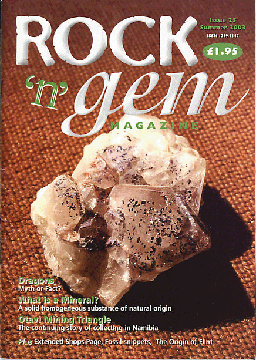
Published Autumn 2003
Contents: Dragons myth or fact, what is a mineral, otavi mining triangle - collecting in Namibia, shops pages, fossils, the origin of flint

Rock n Gem Magazine Issue 40

Rock n Gem Magazine Issue 40
Published Summer 2007
Looking back
Collecting Scottish Agates
Gemstone and Fossil news, directories, listings
or buy via the Earthly Gems website
MOSS and PLUME AGATES
Continuing Barry’s passion for inclusions in anything, this issue it’s Agate.
Plume Agate
Another type of structure often seen is called a plume, here wispy examples can be found in either agates or cut quartz. Inclusions often look like smoke drifting over red flames, like burning stubble on a farm or the Indian Smoke-signals seen in classic westerns. The plumes themselves can comprise various colours and they often have a halo or corona surrounding them. When this structure is identified, it can be found adjacent to or even included with other manganese dendrites. The distinctive types often overlap, plume structures are also found in other material such as jasper.
Moss Agate
This agate type is also referred to as Mocha stone, they are the same type. Moss Agate is a delicate fluffy structure that is often found in agates; here you can imagine walking through an enchanted forest with soft delicate fronds of moss hanging from the branches of trees. Gem cutters will often give the various individual varieties descriptive names, like green moss agate or a yellow moss agate. Three-dimensional green fronds with a moss like structure, similar to dendrites often occur in a translucent or opaque Chalcedony such as the green tree moss agate. Moss Agates are also found in other bright colours, rather than the typical green moss structure we are used to, the background is often very colourful too. The colours are the result of trace amounts of a metallic element usually an Iron oxide.
Fine green fronds or stringers are often found in a translucent chalcedony envelope. Other Moss Agates can often be found in opaque tubes which when cut open or through, reveal the typical green centre in the tubes. A large variety of colourful moss agate types exist, as more and more varieties are discovered every year, this can be very confusing, as the subtle varieties do frequently overlap in the original material. Another moss like agate that is referred to as Mosquito Agate, seems to be a denser form of moss agate, the sample I have is from Botswana.
Cutting and polishing
Unfortunately for the jewellery makers, many varieties of moss inclusions look their best when backlit. When this occurs they are cut into smaller carefully crafted pieces, set with perhaps a reflective backing, or often no backing at all, making maximum use of any available light.
Barry Taylor
Rock n Gem Magazine Issue 24

Published Spring 2003
Contents: Silver minerals, fossil store horrors, refractometers, competition.
Silver Minerals
Silver, Ag, is known as a coinage metal and has an average crustal abundance of 0.08 ppm. Over 10,000 tonnes are produced annually with Mexico, Russia, USA, Peru and Australia being the foremost current world suppliers. Silver is used commercially in photography, silverware and jewellery, silvering mirrors, high capacity batteries, electronics and chemicals. Silver is found mainly as the native element or in countless sulphides, sulphosalts and in halides. Silver occurs in an array of interesting habits and forms very desirable specimens for collectors. Crude masses, wires, sheets, leaves and plates are all very typical for this mineral. Distinct rough cubic crystals are rarer and can include octahedra and dodecahedra. Twinned parallel arborescent to dentritic habits are also very enticing. Its colour is silver-white but this soon tarnishes grey to black with a metallic lustre. It has a variable specific gravity of around 10.5 and has good malleability. It has a shining white streak with a hackly fracture and a low hardness. The above characteristics and simple chemical tests are useful in identifying silver. It occurs as a primary hydrothermal mineral and as a secondary species in the oxidised portions of mineral deposits. Silver is chiefly associated with acanthite, chlorargyrite, various silver sulphosalts and many other minerals. Silver deposits are known throughout the world in many countries. USA, Canada, Norway (Kongsberg being noted for the best crystallised and wire specimens!), Germany, Czech Republic, Australia, Mexico, Peru, Bolivia and Kazakhstan have all produced fantastic specimens. Silver specimens are usually available at Rock "n" Gem Shows. The greatest number of silver-bearing minerals is found among the sulphides and sulphosalts and they provide an interesting group.
Acanthite, Ag2S, is a monoclinic mineral that forms prismatic crystals. Usually found as a paramorph after the high temperature polymorph in pseudo-cubic or pseudo-octahedral habits to several ems in size. Acanthite is iron-black in colour with a black streak and a high specific gravity of 7.2. It has an uneven fracture and a hardness of 2.0-2.5. The habit, lack of cleavage and chemical tests helps towards its identification. It is a widespread mineral of moderately low-temperature sulphide deposits and in secondary enrichment zones, along with silver, pyrargyrite, proustite, polybasite, stephanite, galena, chalcopyrite, sphalerite, calcite and quartz. Good specimen localities are Freiberg, Schneeberg, Annaberg, Marienberg and St. Andreasberg in Germany; countless sites in Mexico; USA; Cobalt area, Ontario, Canada; Chanarcillo, Atacama, Chile and Jachymov, Czech Republic.
Hessite Ag2Te, can be found as appealing pseudo-cubic crystals to about 1.7 cm. Massive, compact or fine-grained aggregates are commonly encountered. It is lead-grey to steel-grey 111 colour tarnishing to black, and possessing a smooth and even fracture. Hessite frequently occurs in low to moderate-temperature hydrothermal veins and in some massive pyrite deposits. It is associated with calaverite, sylvanite, altaite, petzite, gold, galena, tetrahedrite, chalcopyrite and other minerals. Crystal form and chemical tests aid in the identification of hessite. The best samples are obtained from the Bote mine, Zlatna, Romania; Kalgoolie,Western Australia; Altia Mts, Siberia in the former USSR; California, Arizona, Colorado, USA; and in various localities in Canada.
Stromeyerite, AgCuS, generally occurs as massive or compact dark steel-grey aggregates. Orthorhombic prismatic crystals are discovered infrequently. Its physical properties include a steel-grey streak, metallic lustre, nd a hardness of 2.5 to 3. and a subconchoidal fracture. Stromeyerite is mostly encountered as a secondary accessory mineral in hydrothermal deposits. It also is known as a primary species. Freibergite, bornite, chalcocite, chalcopyrite and galena often accompany this mineral. Quite a few localities for stromeyerite are known. These include: Dzhezkazgan, Kazakhstan; Silver King and Magma mines, Arizona, numerous mines in Colorado, USA; Rudelstadt and Kupferberg, Silisia, Poland; Mt Lyell, Tasmania, Australia; and from Cobalt, Ontario and Silver King mine, British Columbia, Canada.
Proustite.AgrAs'Sr, is one of the most desirable minerals to have in any collection due to its beautiful crystals. Great specimens are both difficult and extremely expensive to buy. It forms various hexagonal prismatic crystals to 8 cm in length and can be twinned. Massive to compact aggregates are also found. Proustite is translucent and scarlet-vermilion in colour that darkens with exposure to light. The mineral is brittle with a conchoidal to uneven fracture and a distinct cleavage. It has a low hardness and a specific gravity of 5.5. It has a vermillion streak and an adamantine lustre. It is usually lighter than the next mineral pyrargyrite and chemical tests are useful guides to its identity along with its representative associations. It is found as a late-forming hydrothermal mineral and in oxidised zones, frequently together with silver, arsenic, stephanite, acanthite, tetrahedrite, arsenopyrite, chlorargyrite and barite. Proustite is not uncommon, but only occasionally do localities provide ore or wonderful specimens.
Exceptional crystal groups came from Chanarcillo, Chile; also at Jachymov and Pribram, Czech Republic; Freiberg, Niederschlema and Schneeberg, Germany; from diverse locations in Mexico; Poorman mine, Idaho, USA, and at other sites worldwide. Proustite has occasionally been cut into striking gems, but it is really too soft to wear and also suffers from light damage.
Pyrargyrite, Ag3SbS3, isanother gorgeous silver mineral It crystallises in the hexagonal system with prismatic, hernimorphic crystals that are sometimes twinned. Other habits are massive and granular forms. Pyrargyrite has an amazing deep red colour and is translucent with an adamantine lustre. It also darkens on exposure to light. Other physical properties are a purplish red streak, distinct cleavage, conchoidal to uneven fracture and a hardness of 2.5. Distinguishing features are its crystal habit, the antimony test and its darker hue than proustites. Pyrargyrite and proustite should both be kept out of the light. The mineral is characteristic of late-stage low-temperature primary species in quite a few hydrothermal deposits, and is also found as a secondary mineral. Silver, acanthite, tetrahedrite, other silver sulphosalts, calcite, quartz and dolomite regularly occur with pyrargyrite. Premier specimens are acquired from Colquechaca, Bolivia; Chanarcillo, Chile; Fresnillo, Zacatecas and Guanajuato, Mexico; San Genaro mine, Huancavelica, Peru; St. Andreasberg, Germany and San Carlos mine, Heindelaencina, Spain. Cut stones up to 50 carats have been faceted, but are inclined to be too dark.
The halide class includes: Chlorargyrite, AgCl, bromargyrite, AgBr and iodargyrite, Agi. They are all secondary minerals typically occurring in oxidised portions of silver deposits, commonly in arid climates.
Chlorargyrite is found as attractive modified cubic crystals or more usually as parallel groups, massive, stalactitic, fibrous or as aggregates forming crusts and films. It is colourless, yellowish to grey white when fresh, but turns violet-brown to purple when exposed to light. The mineral possesses a resinous, adamantine to waxy lustre and is translucent to transparent. It is sectile, ductile and very plastic in character. It has a white streak, low hardness and a high specific gravity. Physical characteristics, chemical tests and its mode of occurrence are distinguishing properties. The mineral is associated with silver, cerussite, iodargyrite, atacamite, malachite, jarosite, goethite, and pyromorphite. Fine samples are obtained from many nations. Germany, Czech Republic, England, Russia, USA, Mexico, Chile, Bolivia and Australia are noted sources for chlorargyrite.
Bromargyrite can occur as cubic or cubeoctahedral combinations up to 7 mm across. Ordinarily massive, parallel or subparallel aggregates are found. The mineral is yellowish, greenish brown to bright green in colour and is resinous, adamantine or waxy in lustre. It gives a white to yellowish white streak and has a hardness of 2.5. It is sectile, ductile and very plastic. Bromargyrite possesses a high specific gravity of 6.4 and has an uneven to subconchoidal fracture. The above features and its chemistry aid identification. Normally it occurs together with silver, iodargyrite, smithsonite, wulfenite and various Fe-Mn oxides. Although an uncommon species, it is found at a variety of localities. Good sources include Huelgoat, France; Dernbach and Bad Ems, Germany; in Arizona, New Mexico, Idaho and Colorado, USA; copious sites in Mexico; Broken Hill, Australia and at Chanarcilio, Chile.
Iodargyrite is a mineral with an appealing range of crystals. Prismatic to tabular hexagonal crystals occur with occasional complex pyramidal forms. Lamellar, scaly, globular, rosettes and massive habits also occur. It has a perfect cleavage with a conchoidal fracture and is both sectile and flexible. It has a very low hardness (1.5) and its specific gravity is 5.6. It is usually colourless but becomes yellow on exposure to light. Greenish yellow, brown or grey are other hues commonly encountered. Iodargyrite has a variable lustre ranging from resinous, adamantine to pearly on cleavage. Cleavage and other properties are useful tests for the mineral. Silver, acanthite, chlorargyrite, bromargyrite, cerussite, goethite, vanadinite and descloizite are all closely associated with iodargyrite. It is the rarest of the three silver halides discussed. Delightful examples have been discovered III Mexico, USA, Chile, Australia, Kazakhstan, Germany, Spain and France.
Aurorite, (Mn,Ag,Ca)Mn3073H20, is the only currently recognised silver-bearing mineral which forms an oxide. It sporadically forms in vein lets filling microfractures in calcite. It occurs as small irregular masses and as platy or
scaly grains. The mineral is black and opaque with a low hardness. The specific gravity is estimated to. be about 3.8. Usually associated minerals are todorokite, cryptomelane, pyrolusite, chlorargyrite, silver and quartz. Chemical tests and x-ray diffraction are used in its identification. Aurorite is present at a number oflocations, but is very scarce. Aurora mine and Yucca Mts, Nevada, Ash Peak mine, Sheep Tanks district, Arizona; in the Kawazu mine, Shizuoke Pefecture,]apan are known sites for the material.
The minerals of barium will be discussed in the next issue.
John Betterton
Rock n Gem Magazine Issue 8

Published Summer 1999
Through the looking glass
Magic of Gemstones
Expand your knowledge
Listings, directories
Rock n Gem Magazine Issue 39
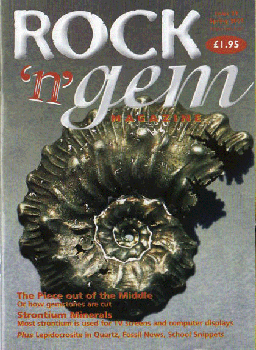
Rock n Gem Magazine Issue 39
Published Spring 2007
Healing Gemstones, Coloured Gemstone Report, Diamond Grading Course,
Fossil News, Lepidocrosite in Quartz, Rockwatch Guide No 1, Piece out of the Middle,
Rock 'n' Gem Shows, Strontium Minerals, Web Directory, Tubes of Escape,
School Snippets, Contemporary Jet, The Value of Nephrite, The Beauty of Opal
Cosmic Diamond, The Mysterious Beauty of Amber, Gemmology BTEC,
Shops Page, Subscribe, Shows and Classifieds.
Mysterious beauty of amber
Being a first year gemmology student I am interested in all the wonderful gems and minerals and amber is among my favourites. Easily accessible in Poland, my country of origin, it was probably the first gem that made me curious enough to start asking questions about it…
Very early in my childhood I was playing with pine’s resin imagining it would soon turn to amber and the biggest attraction during holidays by the Baltic Sea was going to the beach after the storm and collecting small pieces of this gem. My child’s imagination was also stimulated with the story of the mysteriously lost Amber Room. It was not long ago that my knowledge about this organic material shaped up in a more scientific rather than romantic way.
The formation of amber is dependent on the production of tree resin under the conditions enabling the preservation of the hardened resin. There are around 20 rich deposits of amber in the world, among which the two major ones are Dominican Republic and Baltic Sea.
The resin can be produced by various conifer and some tropical trees.The production of it is probably a defence mechanism that trees developed against insects and disease. Moreover when the tree is injured, a resin acts in a similar way to a scab on the human body, as it is excreted, covering the wound and then it hardens. Thanks to this property amber could preserve some incredible inclusions such as spiders, little insects or even a lizard. Inclusions of that type are relatively rare and therefore they are sought after.
Amber can be used in jewellery as well as in the production of decorative objects such as sculptures, chess sets, candleholders to name a few. In the Baroque period the carving of this material was very popular, which resulted in many incredible works of art, among which The Amber Room is probably the most splendid one. The creation of the room was requested by the King of Prussia, Frederic I and it was first carried out by Gottfried Wolffram and Eosander von Göthe. However after the disagreement between the two artists the work moved to the then German city of Gdaƒsk. In 1713 The Amber Room was presented in its full glory in the royal palace at Berlin, and later it was offered as a gift to the Russian Tsar, Peter the Great.The room was put up in the Summer Palace and in 1763 the last finishing touches were carried out. The Amber Room was described as ‘one of the Wonders of the World’1, but unfortunately it cannot be admired today. In 1941 the Germans marched into Leningrad and it is believed that The Amber Room was then transported to the Prussian Fine Art Museum under Alfred Rohde’s discretion. It was moved again after that and that is when all trace of The Amber Room disappeared. Since then there were many speculations regarding the place where it could be hidden, but the mystery remains unsolved. We may not ever know the true story behind The Amber Room as there are no signs of it. What we are left with today is the reconstruction works of The Amber Room based on eighty six photographs and many descriptions, and a hope that the universal beauty of this semiprecious gem will give justice to the lost Baroque work of Art.
Lepidocrosite in Quartz
hope this article will help clear up some of the confusion surrounding the very fine, needle like inclusions in Quartz. Lepidocrosite is undoubtedly a wonderful creation of nature that is often confused with Rutile.
I am convinced the sight of this beautiful mineral and its associations will leave you awestruck.Take a close look at the long strands that are found in clear quartz in what is often referred to as Super Seven Quartz. These crystals often appear to almost glow with both fiery red and glistening black crystal strands, often rival the other well known beauty of fine gold or silver Rutile needles seemingly suspended in an often water clear quartz. Lepidocrosite, as mentioned above can be red, purple or brown shading into black; this is both the charm and also a clue to the origins. As you have probably guessed, Lepidocrosite is in fact a colourful variety of Goethite as a hydrated iron oxide, (see the illustration of Lepidocrosite on Goethite from Spain). Other named varieties are Akaganite and Feroxyhyate, If you are feeling confused, we will ignore the other two rare varieties as they require very specialised equipment for investigation!.
Lepidocrosite often occurs together with bright black plates of Haematite, sometimes in the presence of purple Amethyst, what a combination! In a very different sample from Siberia, you can see thin brown and red mica like plates of Goethite, together with shiny black Haematite, both examples exhibit a similar platy structure of Lepidocrosite, here shading from red to black. Technically this mineral group is known as hydrated Iron oxide, a polymorph of Goethite, having the same overall chemistry but a different crystal form. When strands of Lepidocrosite are found, seemingly floating inside clear Quartz, they frequently outline a quartz crystal phantom. When existing as fine strands these are often elongated sometimes twisted strings, easily recognised, especially when found in water clear quartz. The golden tufts often found in Amethyst are actually yet another variety of Goethite and not the golden sprays of Cacoxenite. The mineral Cacoxenite, is known as a different type of mineral, in fact it is classed as a phosphate mineral; as such it is said to never be found inside Quartz. There seems to be plenty of room for confusion here, not least because Cacoxenite is also listed as one of the seven minerals in Super Seven Quartz. Out of interest, Quartz has another accomplice that is called Moganite, only recently found (1970’s), this is yet another Silicon dioxide mineral, but has a different crystal form to quartz;
it is very difficult to distinguish Moganite from the usual Quartz and Chalcedony. Apparently this mineral occurs in microscopic twisted strands, as Lepidocrosite is also found in more visible twisted strands, is their a possible link? Moganite apparently comprises approximately 10% of any Quartz or Chalcedony, usually found in Agates. The varieties of Quartz with Lepidocrosite crystals inside that are frequently mentioned are listed here.
Harlequin Quartz
Harlequin quartz from Madagascar, displays its beauty in the random inclusion of the Iron rich minerals as bright red flakes and slender strings such as Lepidocrosite, found together with lustrous black Haematite. When the beauty of Lepidocrosite became better known, it has also been reported as appearing in several other locations, including Namibia (Brandberg), Siberia and Brazil.
Fire Quartz
Fire quartz is the name used for the variety of quartz that contains this magical mineral, usually as bright red platy mica like inclusions, as opposed to the String like form. Fire quartz is also often confused with rutile quartz that is coloured by fine needles of red Rutile. There is also a Mexican fire agate that is occasionally called Fire Quartz (a Chalcedony).
Raspberry Quartz
Another colloquial name; this has fallen out of favour due to a manufactured material being given this name in order to increase its commercial value. Cherry Quartz or more recently Galaxy Quartz is the name that should be applied to this decorative material; it is not Quartz and looks man made and as such it often feels warm to the touch.
Strawberry Quartz
Yet another colloquially named variety of quartz, this has thin flakes of bright red Lepidocrosite and is often found in cut and polished quartz cabochons from Brazil. This particular quartz is sometimes accompanied by an unidentified green flaky material in examples from Brazil, another diagnostic and visually stunning combination.
Super Seven Quartz
The large variety of Inclusions found in some Quartz crystals from Espiritos-du-Santos, Minas Gerais, Brazil, are sold by crystal healing fans as either Super Seven Quartz or Melody Stone. Here the Lepidocrosite crystals appear as long thin strands, amongst a combination of Amethyst, Smoky and Clear Quartz. This variety of quartz is said to contain the metaphysical power of all three subtypes of quartz, Amethyst, Smoky and Clear, even when none can be seen? In addition these crystals are said to act as a host for Lepidocrosite, Rutile (unconfirmed), Haematite and strangely Cacoxenite, (probably a bright yellow variety of Goethite)? A similar combination of mineral types has been found in Agate slices.
Brandberg Quartz
Strange Lepidocrosite flakes and strings also occur in the often-patchy variety of Amethyst to be found in material from the Brandberg Mountains, Namibia. These are found here together with fluid inclusions and wispy veils, as well as Amethyst, smoky and clear quartz.
Rock n Gem Magazine Issue 23

Published Spring 2003
Contents: Namibia minerals from the Aris quarry phonolite, the caduceus, rock n gemmers in China! Quiz and news.
Rock n Gem Magazine Issue 7

Published Spring 1999
Minerals and Gems of Scotland
Rockwatch 1998
Ornamental Oddities
Letters, Shops, Directories
..Coloured Gemstone Market Report ..
The coloured gemstone business is much affected by geo-political considerations. Sources of rough stones in a given country may be thought to be sound, and then a revolution occurs - or the economy collapses - or
there is bad weather - or some other factor causes that place of origin to evaporate, and a fresh search ensues for suitable stones elsewhere in the world, It is an ever-changing scene.
EMERALDS. Colombian sourced stones are reaching the market in commercial grades, and are plentiful. The expectation that Russian mined emeralds would feature as a major supplier in order to help alleviate their precarious economic position has not materialised.
SAPPHIRES. Demand for good grades of Sri Lankan (Ceylon) sapphires remains firm, as does the price. The lower grades are easing in price due to the widespread recession in Asia.
AQUAMARINES. The better qualities selling in the trade at £220 per carat and upwards are harder to find. Existing stocks in the cutting centres for commercial grades, mostly from Africa, are adequate.
TANZANITE. It is about a year since the flash floods in Tanzania killed many miners, and production is not yet meeting demand. Prices for good stones have risen considerably in recent months. There is an abundance of poor quality rough saturating the market and there are few buyers for it.
CORAL. There is a shortage of coral with the ox-blood colours more expensive than the pink.
TSAVORITE. This green garnet is gaining in popularity with pleasing looking stones up to 2.50 carats available with prices steady.
AMETHYSTS. There was quite a vogue for the paler amethysts at one time but this preference has given way to increased demand for the stronger colours. Prices are stable, as stocks are adequate to meet demand.
TOURMALINES. Superb rubellites, the red tourmaline, are available with larger ovals above 10 carats from £220 per carat. Beautiful specimens in smaller sizes and most shapes for under £200 per carat. These stones are well worth looking at as an alternative to ruby for those wanting a red stone. Pink tourmalines, mostly from Nigeria, are particularly pleasing in both faceted and cabochon forms.
GARNETS. Always plentiful except the better rhodolite garnets sourced in Tanzania which were much affected last year along with the tanzanites by flooding of the mines. Prices are expected to remain stable from now on.
PEARLS. White pairs of South Sea pear-shaped cultured pearls 12-13m111 long of good quality can be £1200 per pair. Single stones are less than half the price of the pairs. Cultured black and grey Tahiti pearls have fallen in price due to the economic woes of Asia and the subsequent lower demand. Good Chinese saltwater pearls find their way on to the market via Japan, which helps moderate the price of 7-8mm items.
WHAT IS MOVING AND SHAKING THE DIAMOND MARKET.
Apart from the USA, slow pre-Christmas sales were reported, as demand from the Far East remains weak. The good news from Japan is that cutters supplying the hearts and arrows ideal make as it is called, said that demand was strong. The 'hearts and arrows' ideal make, a modified round brilliant, when viewed through a specific arrangement of lenses displays a reflective effect of hearts and arrows within the stone. These stones are sold to Japanese couples for engagement rings showing that even in the worst recession that the emotional sales remain strong is a lesson for us all if there is some belt-tightening
in the months ahead. The US dollar remains supreme as the international currency in which diamonds are traded. Our view is that the Euro is unlikely to take over from the dollar, as some would have us believe.
Information supplied by R.M. VJ.0are& Co Ltd of York.
Rock n Gem Magazine Issue 38

Rock n Gem Magazine Issue 38
Published Winter 2006
Contents: Healing Gemstones pt 4, Coloured Gemstone Report,
Fossil News,Dedritic Quartz and Agate, 40 Years of Agate Hunting,
letters,Rock 'n' Gem Shows, Rare Earth Element Minerals,
Tubes of Escape, Not Just Rock Crystal,
Demantoid Garnet, Padparadscha Sapphire, The Wonder of Labradorite,
Shops Page, Web Directory, Subscribe, Shows and Classifieds.
Rare Earth Element Minerals
The rare earth elements (REE) or lanthanides form the largest
chemically coherent group of elements in the Periodic Table.
“Rare” earth elements is a historic misnomer; persistence of the term reflected unfamiliarity rather than true rarity. Even the least abundant REE lutetium at 0.32 ppm is nearly 200 times more common than gold.While the commonest REE cerium at 64 ppm is about 5 times as abundant as lead. In mineralogy the term REE is often restricted to the lanthanides plus yttrium and lanthanum, they show very similar chemical behaviour and thus we shall treat them together here.
THE LANTHANIDE ELEMENTS
(with names and symbols)
Ytrrium,Y Lanthanum, La, Cerium, Ce Praseodymium, Pr, Neodymium, Nd Samarium, Sm, Europium, Eu Gadolinium, Gd, Terbium,Tb Dysprosium, Dy, Holium, Ho Erbium, Er, Thulium,Tm Ytterbium,Yb, Lutetium, Lu The element Promethium, Pm has no long–lived nuclei, therefore has no natural abundance. These elements have traditionally had a different naming system as compared to other minerals (recently adopted for other minerals). The name of the mineral has a suffix indicating the dominant REE in the formula e.g. bastnasite-(Ce) where known. The most abundant lanthanides are cerium, lanthanum, neodymium, and yttrium, and it is those elements that appear most frequently in mineral names.World production stands at over 107,400 thousand tons per annum. The main current producers are China, USA, India and Australia. Some of the numerous uses include catalysts, ceramics, metallurgy, electronics, TV phosphors in CRT and LCD displays, lasers, batteries, computers (in disk drives and DVD drives), permanent magnets, fibre optics, medical imaging equipment, lighter flints, polishing powders, automotive catalytic converters and lighting applications. Newer applications are found in magnetic refrigeration, fuel cells, super conductors, data storage and magnetostrictive alloys. Over 180 different minerals are known to contain essential lanthanides and this list continues to grow. Their representatives can mainly be found within the silicate, oxide, carbonate, phosphate, arsenate and halide classes.
Euxenite-(Y), (Y,Ca,Ce,U,Th)(Nb,Ta,Ti)2O6, forms orthorhombic, stout, prismatic crystals to 10 cm in size and may be flattened in character. Radiating and compact aggregates are also known. Twinned crystals are frequent. The colour is black to brownish black or greenish black with a brilliant submetallic,waxy to resinous lustre. It is opaque being translucent only on thin edges and has a yellowish, greyish or reddish brown streak. A conchoidal to subconchoidal fracture is present with a hardness of 5.5-6.5. The specific gravity ranges from 5.3 to 5.9. The mineral can be weakly radioactive. Mode of occurrence, chemistry and physical properties are useful for identification. It is a widespread species in modest quantities within granite pegmatites and as a component of detrital sands. Common associates include albite, microcline, biotite, muscovite, ilmenite, monazite, xenotime, zircon, beryl, magnetite, garnets, allanite and many others. Plentiful occurrences are known and some of these are found in Norway, Sweden, Russia, Italy, Madagascar, Brazil, Canada, USA and Australia.
Davidite-(La),
(La,Ce)(Y,U,Fe)(Ti,Fe)20(O,OH)38, is a primary mineral in high-temperature hydrothermal veins, norites, anorthosite, alkali rocks, granite pegmatites and carbonatites. Rutile, titanite, magnetite, ilmenite, apatites, tourmalines, epidote, albite, scapolite and calcite usually accompany Davidite-(La). Hexagonal rough crystals can be flattened, cuboidal or pyramidal in form.Twinned crystals are not rare. Irregular masses and grains also form. Colour ranges from black, grey, brown or reddish when altered.The lustre is vitreous to submetallic with a greyish black to dark brown streak. It is opaque, only translucent in very thin fragments. A subconchoidal to uneven fracture is noted and is brittle.The hardness is around 6 with a specific gravity of 4.3-4.4. It may be radioactive and is commonly metamict. Mode of occurrence, chemistry and physical properties are useful recognition features. Davidite-(La) is of worldwide distribution. Large crystals come from Mavusi,Tete district; at Matema and Campangula, Mozambique. Other places for samples are found in Australia, Russia, Norway, Sweden, Spain, Austria, Kazakhstan, USA and in Canada.
Fluocerite-(Ce), (Ce,La)F3, hexagonal crystals may be prismatic to tabular or flattened in habit. Intergrowth with oriented bastnasite and mutilamellar twinning is common. Massive, granular and pebble forms are also found. A prefect cleavage and a poor subconchoidal to uneven fracture are present. The hardness is between 4 and 5. The mineral may be pale yellow to colourless when fresh and reddish brown when altered. It is transparent to translucent with a vitreous to resinous lustre and pearly on cleavage surfaces. The specific gravity is high at 5.9 to 6.1. Physical, chemical and x-ray properties are used for characterization. Fluorcerite-(Ce) is a mineral of replacement bodies in zoned granite pegmatite environments and in hydrothermal deposits associated with greisenization. Bastnasite, cerianite, parisite, monazite, allenite, thorite, zircon, fluorite, microcline and quartz are frequent associates.A wide selection of sites has produced representative specimens and includes: Sweden, Norway, Germany, USA, Nigeria, Japan, Russia, Ukraine, Kazakhstan, Kyrgyzstan and Mongolia.
Bastnasite-(Ce), (Ce,La)(CO3)F, is the most abundant REE-bearing mineral, typically hydrothermal, in granite, syenite and pegmatites, carbonatites, in contact-metamorphic deposits and rarely in placers. Other enticing REE minerals such as allenite-(Ce), cerianite-(Ce), synchysite-(Ce), parasite-(Ce), fluocerite-(Ce) and fluorite, barite, pyrite, glaucophane and galena can occur with bastnasite-(Ce). Hexagonal tabular to equant crystals are common, may be modified by several forms and up to 20 cm in size. Horizontal striated crystals also occur and are frequently syntaxically intergrown with several other REE minerals. Granular to massive aggregates also occur. Several poor to perfect cleavages are present with an uneven fracture. The mineral is brittle and the hardness is 4-4.5. It is wax-yellow, honey-yellow to reddish colour and is transparent, translucent to near opaque. The lustre is vitreous, greasy to pearly. Specific gravity is 4.9 to 5.2 and is strongly piezoelectric in character. Physical and chemical properties are useful characteristics. Some of the copious sources are found in Sweden, France, Turkey, Russia, Afghanistan, Pakistan (large crystals recently, some faceted to over 18 carats!), Madagascar, Tanzania, Malawi, Zambia, USA, Canada, China and elsewhere.
Tundrite-(Nd), Na3
(Nd,La)4(Ti,Nb)2(SiO4)2 (CO3)3)O4(OH).2H2O, can be found as spherulitic masses up to 5 mm in size. The mineral is brownish to greenish yellow and is translucent in character with a vitreous lustre. The hardness is 3 and the specific gravity is 4.0. It has a white streak. Chemistry, x-rays and single locality may identify this complex triclinic carbonate-silicate. Tundrite-(Nd) occurs in pegmatite veins associated with a layered nepheline syenite, and is found with microcline and arfvedsonite. Specimens have been obtained from the Ilimaussaq intrusion, Kringlerne, Kangerdluarssuk Plateau, Greenland.
Monazite-(Ce), (Ce,La,Nd)(PO4), can reach to 26 cm in size and over 25 kg in weight! Collectors can expect a varied and interesting crystal morphology that ranges from tabular, prismatic, equant to wedge-shaped character with affluent forms. Twinned crystals are frequent as are contact twins. Massive and granular aggregates also occur. The colour can be white, brown, red, pink, yellow, grey and greenish, and is transparent to opaque. Streak is white to pale brown and the lustre is resinous, waxy to adamantine. Several distinct to poor cleavages are noted with a parting and possess a conchiodal to uneven fracture. It is brittle and has a hardness of 5-5.5. The specific gravity varies from 4.9 to 5.4. It often exhibits the alexandrite effect.The mineral may be radioactive if thorium-rich. Monazite-(Ce) is a widespread accessory mineral of granites, syenites and their pegmatites, in fissure veins, high-grade metamorphic rocks, charnockites and in weathering zones. It is also commonly detrital in river and beach sands. It is regularly associated with zircon, xenotime, titanite, allenite, columbite, wolframite, barite, biotite, feldspars, beryl, quartz, tourmalines, uraninite, cassiterite and many REE minerals. Monoclinic habit, occurrence, physical and chemical properties are distinguishing characteristics.There are countless occurrences for excellent collector specimens. Typical of these can be located in Russia, Norway, Romania, Czech Republic, Italy, Switzerland, France, Congo Republic, Madagascar, Malawi, Namibia, South Africa, USA, Brazil, Bolivia, Japan, Australia and China. Only small gemstones have been cut of this material.
Monazite-(Sm), (Sm,Gd, Ce)(PO4), is the first samarium dominant mineral to be discovered. It is know from the Annie claim No. 3 pod, Greer Lake intrusion, Bird River, Greenstone Belt, Manitoba, Canada and in theBelaya Zima deposit, Sayan Mts,Tuya Republic, Russia. It occurs as miniature tabular, white to pale yellow, monoclinic crystals with a vitreous to greasy lustre. This has a white streak and is translucent in appearance. A good to distinct cleavage is noted and has a specific gravity of 5.5. The mineral is scarce and is found with manganocolumbite in a lepidolite pegmatite. Monazite-like habit, chemistry and limited occurrence contribute towards its identification.
Allenite-(Ce),
(Ca,Ce,La)2(Al,Fe,Fe)3(SiO4)(Si3O12(OH), forms monoclinic, tabular, prismatic to acicular crystals over 90 cm in length.They can show a range of different habits and polysynthetic twinning is common.Well-crystallised material is commonly metamict. Granular and massive habits are also encountered. The cleavage is imperfect to poor with a conchiodal to uneven fracture and is brittle.The hardness is 5.5-6 and the specific gravity is variable from around to 3.5 to 4.2. Various shades of brown, red and black are present, and can be colour-zoned with a vitreous, resinous to submetallic lustre. It can be translucent to opaque. The streak is grey. Physical properties, chemistry and x-rays are useful for distinguishing this species. Allenite- (Ce) is a characteristic accessory mineral of granites, granodiorites, monzonites, syenites, rarely in schists, gneisses, skarns and some contact metamorphosed limestones in large amounts. It can be a clastic member of sediments. Epidote, muscovite, fluorite, quartz, feldspars, various amphiboles, micas, chlorites, calcite, zircon, uraninite, talc and various REE minerals normally occur with allenite-(Ce). Some countries that afford good crystals or rich material follow: Greenland, Sweden, Norway, Finland, Russia, France, Germany, USA, Canada, Mexico, India, Australia, Mozambique and South Africa. Since it is often dark the mineral is seldom faceted apart from cabochons.
Keiviite-(Yb), (Yb,Y)2Si2O7, is a uncommon mineral of pegmatites and occurs with microcline, fluorite, bastnasite, higganite and wulfenite. It forms elongated platy and prismatic crystals that are monoclinic in character. Polysynthetic twinning is frequent.The mineral is colourless with a vitreous lustre. A perfect and imperfect cleavage is present. The specific gravity is high at 5.9 with a hardness of 4 to 5. Its chemistry and x-rays best identify this species. Its sole locality is Ploskaya Mt, Keivy massif, Kola Peninsula, Russia. Minerals containing the element strontium will be discussed next.
John Betterton
Rock n Gem Magazine Issue 22

Published Winter 2002
Contents: Potassium minerals, polishing stones by hand, Namibia first impressions - Sussex Mineral & Lapidary Soc., awards, quiz, news.
Rock n Gem Magazine Issue 6

Published Winter 1998
Faceting Designs
Gem Industry of Sri Lanka
Whitby Jet, How to cut jade, emeralds from Afghanistan
Listings, Directories
Rock n Gem Magazine Issue 37

Rock n Gem Magazine Issue 37
Published August 2006
Contents: Healing Gemstones pt 3, Coloured Gemstone Report,
Fossil News, Paul Butterworth, Sagenite Formation,
The "Beauties & the Beasts", Lithium Minerals Shops, Rock 'n' Gems Shows,
A Little Bit of Rough, Agates, Subscribe, Shows & Classifieds.
Rock n Gem Magazine Issue 21

Published Autumn 2002
Contents: Journey to Tafilalt, malachite, conference, market reports, healing crystal, book reviews and news.
Rock n Gem Magazine Issue 5

Rock n Gem Magazine Issue 5
Published Autumn 1998
Synthetic Moissanite
Seaside Geology
Gem Testing
Quiz, Listings, Directories
Rock n Gem Magazine Issue 36

Rock n Gem Magazine Issue 36
Published Summer 2006
Contents: Healing Gemstones pt 2, Mendip Miracle, Fossil News,
Tribute to Ken Luff, Fibrous Inclusions, Making a Chain.. (by Rolf Harris),
Tellurium Minerals, Shops Page, Kimberley Process, Letters, Subscribe
Shows and Classifieds
Rock n Gem Magazine Issue 20

Published Summer 2002
Contents: Aluminium minerals, pebbles from the beach, books, news and reports.
HEALING CRYSTALS
Throughout history mankind has been fascinated by the beauty of the mineral kingdom.
This chart describes the healing properties of the most popular crystals to help you access their magical and transformational powers. Enjoy!
AGATE - A form of chalcedony found in many varieties and colours, exhibiting banded layers and unusual patterns. High;y valued in ancient cultures, this is a popular talisman for protection, good fortune and good health. As it connects our intuition with the earth, it is excellent for dowsing and use in earth healing . Promotes self awareness, gives stamina, strength and durability.
AMBER - A fossilised tree resin from pine trees dating back 20 40 million years. It radiates sun and solar energy. Transmutes negative into positive energy, promoting positive thinking and attitudes. A good luck charm for travellers. Activates the solar plexus and root chakra, amber revitalizes mind body and soul and helps to relieve depression. Supports physical healing and detoxification. Indicated for disorders of the adrenals, liver and spleen. Gives pain relief for teething children and aids healing of wounds.
AMETHYST - A form of quartz from a light violet to an amazing deep purple colour. 'The Stone of Meditation and Spiritual Guidance' Amethyst opens the crown and third eye chakra, enhancing the connection to the cosmic forces, spiritual guidance, visionary states and psychic awareness. Promotes a healthy spiritual lifestyle. Brings deep healing sleep, and helps reduce pain, especially headaches. Amethyst is essential for placement in sacred space,meditation areas as well the altar. The Queen of the Healing Stones!
APOPHYLLITE - A member of the zeolite family. Grows in 4-sided pyramid shaped structure, 'The Stone of Joy and Happiness' it opens the crown and the third eye chakra. Highly successful in relieving headaches and migraines. Eases aches and pains. Enhances dreamwork and helps to disperse negative energies from computers, It is a favourite for space clearing in Feng Shui.
AQUAMARINE - A transparent form of beryl ranging from blue to blue-green. 'The Stone of Courage', it boosts the third eye and throat chakra. It gives strength to deal with difficult situations, staying focussed under pressure and recognition of the truth. Fine tunes your spiritual awareness, bringing clearer insight and communications on all levels. Soothes refreshes and calms the central nervous system. Promotes creative expression, and courage in speech.
AZURITE - A light to deep royal blue mineral. 'The Stone of Wisdom and Knowledge'. It promotes deep spiritual insights and enhances psychic work. Azurite helps develop intuition, psychic vision, channelling abilities and access to spiritual guidance. A 'Decision Maker', it promotes decisiveness, self-confidence, self-expression and creativity. A stone of great depth and mystery.
BLUE LACE AGATE - A light blue form of agate displaying beautiful white lacey patterns. Gentle activator of the throat and third eye chakra. 'The Stone for Expanding Consciousness and Awareness'. Helps you maintain a high level of consciousness and promotes qualities of kindness, patience, wisdom and peace. Elevates you to higher levels of spirituality. It calms the mind and nervous system.
BLACK TOURMALINE - One of the best stones for protection and grounding. Absorbs negative energies from electrical appliances, and prevents nightmares. Placed around the home it protects the whole environment from negative energies, and so needs regular cleansing.
CALCITE - Found in a wide range of colours, often displaying beautiful rainbows. Works on different chakras according to the colour. Acts as an energy amplifier. Brings laughter, happiness and humour. Promotes spontaneous action as well as positive thinking. Helps reduce fear, strees and tension.
CARNELIAN - A form of chalcedony, ranging in colour from yellow and orange to red. 'The Stone of Action', it activates the naval and solar plexus chakras and enhances the flow of life force. It supports all forms of activity. It helps to overcome apathy, shifting you into action mode. Increases vitality and activates sexual energy. Recommended for disorders of the liver, gallbladder, kidneys, neuralgia and M.E.
DIAMOND - The rarest, hardest and most precious of all gemstones. 'The Supreme Being' within the mineral kingdom. A Master Healer, it activates the crown chakra and aligns all other chakras. It expands and strengthens your whole energy field, helping you to reach your fullest potential on all levels. The most famous symbols of everlasting love, its energy assists in all relationship situations encouraging trust and constancy.
EMERALD - A member of the beryl family of vibrant green colour, 'The Stone for Lasting Beauty and Relationships'. Opens the heart chakra and attracts harmony and tranquillity. Improves the eyesight and strengthens the heart and the immune system. What a beauty!
FLUORITE - A transparent mineral often found in layers oof different colours. 'The Stone for the Mind', it helps with learning and absorbing new ideas. It brings order to chaos and inspires an expanded view. Attracts harmony and tranquillity. Good against flu, colds and sinus problems.
GARNET - A deep red stone also found in light pinks and rare greens. Activates the Kundalini energy. It fires uo the root chakra, boosting and energising the whole chakra system and giving you extra energy and endurance. 'The Stone of Physical Strength', it enhances love life, sexual drive and promotes good health and vitality.
HAEMATITE - An opaque silvery black stone of heavy weight and metallic lustre. Activates and energies the root chakra. A stone for grounding and centering. Brings into balance your male and female aspects. A high Iron content makes it beneficial for blood disorders. Also used for fever and high temperature.
JADE - An opaque stone ranging from white to dark green. A traditional talisman, a stone for good health, physical strength, fertility and longevity. Jade is also a dream stone - assisting in dreamwork. As a heart chakra activator jade promotes love, courage, wisdom and is often associated with Quan Yin, the goddess of compassion and mercy.
JASPER - A form of chalcedony most commonly coloured orange, brown to red. Jasper is a stone for grounding, protection and all aspects of health. Its 'yang' energy revitalizes and nurtures body and soul. It connects with the energies of the earth, making it ideal for dowsing, to connect to the earth energies and helping you to understand the web of life.
LABRADORITE - OFF grey colour, it displays spectacular flashes of moving colours in blue, red, gold and bronze green. A stone for mystics and psychics. 'The Stone of Destiny' it helps you to find your true path, enhances patience and a knowing of 'right timing'. Also called the Druid Stone. It helps you to access the Merlin energy.
LAPIS LAZULI - A classic deep blue stone with flecks of pyrite. 'The Stone of Self Knowledge and Self -Expression', it stimulates the throat and third eye chakras. It aids psychic ability, spiritual visions and insights. It helps you to overcome depression and to speak up for yourself. Boosts the throat, thymus, and the immune system.
LARIMAR - An extremely rare gem, a form of pectolite. An opaque stone of beautiful blue colour. 'The Atlantis Stone', it connects with the Lemurian and Atlantian knowledge. It's playful, innocent, gentle and intelligent (also named the Dolphin Stone). It activates the tree higher chakras, brings inspiration, imagination and understanding.
Rock n Gem Magazine Issue 4

Rock n Gem Magazine Issue 4
Published Summer 1998
What a load of old fossils!
Introduction to faceting
Fossil news
Letters, Shops, Directories
Rock n Gem Magazine Issue 35

Rock n Gem Magazine Issue 35
Published Spring 2006
Contents: Healing Gemstones, Cheltenham Show , Chameleon Diamonds ,
Coloured Gemstone Report. Fossil News,
Magical Foils, Colloidal Particles, Quick Tides,
Grantown Museum, Sodium, Minerals, Shops Page,
Jewel of the Caribbean Letters,
2006 Rock 'n' Gem, Dates Subscribe
Rock n Gem Magazine Issue 19

Published Spring 2002
Contents: Journey to Tafilalt series, location where to collect in the UK, moldavite, quiz and news.
Rock n Gem Magazine Issue 3

Published Spring 1998
Rock n Gem Magazine Issue 3 The Art of Dopping
Rockhound challenge
So what do you do?
Book Review
The Magic of Gemstones
(by Lui Krieg)
Healing Stones and their Properties
Gemstones are called Healing Stones if they have a noticeable effect on our physical, mental or spiritual wellbeing. The electromagnetic field of the stone interacts with the human body to transmit its ul11que information. This information is made up by the structure, mineral
content, vibration and colour of that particular stone. Th is triggers a certain reaction in our body when the healing is taking place. Stones that are used like this on a medical or therapeutic level are called Healing Stones.
Quality is most important! For best results these healing stones have to be genuine, of good quality and completely natural.
There is a direct link between the quality of the crystal and the quality of its properties. It is also important how the stone has been worked with.
If it has been cut, put into a certain shape or set into a piece of jewellery this can increase or decrease its powers.
Some gem stones on the market today are synthetically manufactured, radiated, heat treated, coloured or enhanced in different ways.
The usually loose some or all of their natural healing properties. So if you are looking for a good healing stone you are advised to shop around and seek professional advice if in doubt.
Always remember, if you buy a gem stone, what you pay for is the milling, cutting, shipping or handling, but all the magical powers, the healing properties and all the beauty are free for you to enjoy!
The Healing Properties of Gemstones
AGATE - A form of Chalcedony. Powerful physical healer, good for grounding and energizing. Stabilizes the energy field (aura); helps you to observe, change or accept personal circumstances. Balances male/female energy.
Also has protective qualities and eliminates negative energy.
AMBER - a fossilized resin from prehistoric trees. Has a very bright and positive energy, helps to transform negativity, helps to heal wounds physically and emotionally, works best in the naval and solar plexus area, stimulates and spiritualises the intellect, brings out artistic talents, has been given to warriors for good luck"
AMETHYST - from the quartz family The queen of the healing stones, activates the third eye and crown chakra and aids spiritual well being and contentment. Transmutes lower nature onto a higher and purer level, aids transformation on all levels. It helps to stabilise and strengthen one's energy level. It is "the stone of meditation" and aids psychic and channelling abilities, helps to find inner peace.
AQUAMARINE - a form of Beryl. It clears the mind and helps to express creativity and spiritual insight, calming, soothing and refreshing for mind/body/spirit. Accelerates spiritual and intellectual progress, "the stone of courage", gives you the strength to get through difficult situations. Works best on throat and third eye, and heart depending if blue or green.
AVENTURlNE - From the quartz family. Very calming and relaxing, purifies the mind and the emotions, promotes a positive attitude towards yourself and life, it activates the heart chakra and brings out love and affection.
AZURITE - Has a high copper content. Activates the third eye and throat, helps to give spiritual guidance and insight and helps you to express yourself in the best way. Helps to develop intuitive, psychic and channelling abilities, gives the courage to speak up for yourself at the right time or to remain silent when necessary. Very helpful for meditation to reach higher levels. Azurite and Malachite love to grow together and help the qualities of the mind (Azurite) to interact smoothly with the qualities of the heart. Help to express yourself from the heart.
BLOODSTONE - a form of Chalcedony. Refreshes, strengthens and oxygenates the blood stream, vitalizes the heart and brain functions, also used in the treatment of the spleen, kidneys, bladder and liver, reduces stress and tensions. Helps in the renewal of love, relationship and friendship. Connects the root chakra with the heart.
BOll STONE - A unique healing stone recently found in the USA made up mainly from Pyrite and Palladium. They come in paired as male and female. Very good grounding stone. Balances male/female energy. Cleans, recharges and stabilises the aura and removes any blockages. Helps to align the chakras. Relieves pain and discomfort.
In the next issue Lui will continue Iisting the most popular gemstones and their healing properties. Lui and his partner Tessa are owners if the Stone Age Shop and Crystal Healing Centre in the courtyard at Glastonbury. RG
Rock n Gem Magazine Issue 34

Rock n Gem Magazine Issue 34
Published Winter 2005
Contents: Crystal Skulls, Living Space within Quartz, John Hamer Collection,
Coloured Gemstone Report, Fossil News, Ghosts, Phantoms & Veils, Minas Gerais,
Manufacturin Diamonds, Hardness< Burma Ruby Mines Co,
Pearls are in Vogue, Bismuth Minerals, Letters,
Shops Page, Rock 'n' Gem Shows Subscribe, Shows & Classifieds.
..Coloured Gemstone Market Report..
regular feature provided by R M Weare & Co
A new source of Amethyst is being produced from a deposit in Northern Cambodia. The stones being produced have a lavender hue, with pink undertones, and more brilliance than traditional sources from Brazil and Zambia. The deposit is located on the isolated Laos-Cambodia border and production is on a, as yet, small scale.
The recent Bangkok Gem and Jewellery Fair has highlighted the difficulty to source good quality cut gem material in Sapphire and Ruby. China's unequalled ability to cheaply cut material is forcing cutters in the established cutting centres of India and Thailand to compete by producing higher production rates at decreased costs, the result being a decrease in the cost of commercial goods and premiums on top quality material.
There has been a lot of interest in the new sources of pink sapphires and star rubies that have recently started production in Madagascar. Appraisal of these sources is currently being carried out by the International Coloured Gemstone Association and Madagascar's Service des Mines.
Pakistan's strong showing at the Bangkok Gem and Jewellery Show was aimed at increasing the industry knowledge of the vast range of gemstones that are available from within the country. Pakistan is already recognised as a source for Peridot, Ruby, Aquamarine, Tourmaline, Kunzite, and Lapis Lazuli, but it also has major sources of pink beryl's, diopside, epidote, garnets (of most varieties), moonstone, quartz, sphene, and zoisite.
A new source of sapphire in Malawi is producing good quality calibrated material. Reportedly similar in appearance to Thai Sapphire, production will increase when more of the extracted material is heat-treated. The United States company behind this, Columbia Gem House Inc, is to market the material with a range of selling tools to support the brand.
There have been many requests for cheaper pink stones, as pink sapphire prices continue to rise. Of particular interest to designers have been vivid pink Tourmalines and Rubelltites, particularly in cushion shapes. Morganite and Kunzite are still popular, but there has been a noted shift towards deeper colours with enquires for Bixbite and other unusual stones. Pink Cubic Zirconia sales are very strong. As predicted, emerald and peridot have been very popular over the summer period, especially in larger emerald cut stones. There has been increasing interest in opaque greens particularly in Jadeite and Chrysoprase Conna- Mara marble has been mentioned more than a few times as well! Paler coloured blue stones are in demand with requirements for Apatite and Zircon being of note.The lack of security in both Afghanistan and Pakistan is still keeping prices high. However, cost-conscious customers are showing reluctance to pay the higher price for the better material, and there has been an increasing acceptance for lower quality material. The popularity of lapis means that eventually the higher asking price will prevail.
Fine goods and large sizes in some categories are fetching much higher prices as a consequence of diminished supply. It is often difficult to find these stones even when money is not the limiting factor. Quite simply, the rough is not being found from which to cut the desired top grades, or large items, or both. As a result, many commonplace gemstones above a certain size leap in price.
Crystal Skulls
Over the last decade there has been a large interest in the origins of crystal skulls; how they were made and what they were used for. But if we take a deeper look into the history of man, we can see traces of this mystery dating back to our ancestors. Albeit few priest or shamans that used them in the days of old their use is clearly evident.
The skull symbol represents many things, but its main aspects are protection, knowledge, life- force and death. These three qualities we can easily see when we look at what the skulls functions are during the life of a human. The skulls first and major priority is to protect the brain from physical damage, a very sensitive and
delicate organ for all its power, that once harmed can lead to complete disability as in a major accident or partial loss of control after a minor injury. The brain is where we house all our
collective knowledge in the form of memories. From an early age we learn from direct experience through interaction with life as well as from others experiences via reading and
verbal teachings. This knowledge has been passed down through generations and brought us to this modern age. Many ancient medical as well as shamanic belief systems thought that the life force of a human was stored in the brain. Finally the skull is only ever seen after someone has died and so represents death. This was always seen as change and the opening to new pathways and not as a bad omen. The belief in the powers of the skull are what led shamans and ancient orders of priests to use this symbol during rituals and ceremonies.
Some even created beautiful works of art such as the "Anna Mitchell Hedges" skull which is a life size skull carved completely out of quartz.
It is this skull that has caused such a stir over the recent years as science has been unable, through analysis and experiments, to label it in their parameters as the workmanship is so great they can't even date it or explain how it could have been made.
There are many theories that the skull was passed down through generations and each polished the skull a level further with fine clothes until it was complete. Being made out of quartz adds another dimension to the skull.
Quartz crystal has huge and almost limitless powers, it can store and transmit energy, it can be programmed to do specific tasks as well as purify, magnify and transmute energy. This makes the Crystal Skull a very powerful tool to use indeed, especially in the field of crystal healing and it's in this field that I wish to work with and look at in this talk. The hardest part is to find a crystal skull that resonates with you, there are many to be found but finding the right one can take time. Once you have a crystal skull it will have to be cleansed and dedicated to you. This is best done using flowing water over the skull as you channel the intent of any unwanted energies leaving the skull with the water. Then holding the skull in your left hand place the right hand over the skull and program it with the dedication to the good of all, to protect you in a sphere of bright white light, and lastly add the personnel line that you wish the crystal skull to work on for you. For example if you have a bad back you can ask the skull to help you heal your back.
Once this is complete, the skull will continue to emanate its healing energies and help to you until the programming is cleansed and you start again.
It is a good idea to make a shrine to place the skull on, maybe with a picture of you as well as other power items such as other crystals, herbs, incense, candles and bells. This will all help to create a more powerful energy to work with. Once this is all set up, all that's left to do is to find time each day to sit and meditate in front of the shrine, or to remove the skull and sit somewhere peaceful with it. Twenty to thirty minutes a day is a good time to spend in practice. While sitting start by looking deep into the crystal skulls eyes and allow yourself to relax; taking deep breaths and sighing the air out can help. Imagine yourself sat inside your crystal skull, feeling protected and relaxed, at ease with yourself and everyone else in your life. Let the healing energy of the crystal skull emana rough you. Sit with your back t and your hands cupped in your lap th the crystal skull cradled in them. With your eyes closed try to keep your internal focus on the crystal skull, remembering the sensations that you felt while looking deep into its eyes. If this is too strenuous, it is also possible to lay down with the crystal skull placed on the floor just above your head looking down your body; this also allows the healing energy of the skull to pass down into the body. This can be enhanced by placing quartz crystals in a circle around you; pointing inwards, at least 4 are needed but 6 or 8 are better.
This is an aerial view of the crystal healing grid to be used. The arrows represent the crystal points the tip of the crystal the arrow head. The eclipse represents the crystal skull and the text where you would lay down to heal. This would be a very powerful way to work with a crystal skull.Again for the best results its best to practice daily for 20 minutes and is much better than doing 2 hours once a week. As with all crystal practice it is a very personnel experience, you may find it helpful to keep a journal of your experiences as this will show you the progress you are making. Most of all remember to enjoy the experience, healing is gentle and fun, not all serious!
Lastly I would like to mention that there are many gemstone skulls available, and each gemstone type will have different healing properties according to its nature. The pictures show a few that are available, sugilite, smokey quartz and aqua aura.
R Evans
Fossil News
A collection of fossil snippets from around the world, by S Cohen
From Bill Brysons 'A short history of nearly everything' about the rivalry between American dinosaur hunters Cope and Marsh. "They had much in common. Both were spoiled, driven, self-centred, quarrelsome, jealous, mistrustful and ever unhappy. Between them they changed the world of palaeontology. They began as friends and admirers even naming fossil species after other and spent a pleasant week together in 1868. However something then went wrong between them - nobody is quite sure what — and by the following year they had developed an enmity that would grow into consummate hatred over the next three decades. It is probably safe to say that no two people in the natural sciences have ever despised each other more. Marsh, the elder of the two by eight years, was a retiring and bookish fellow, with a trim beard and dapper manner, who spent little time in the field and was seldom very good at finding things when he was there. On a visit to the famous dinosaur fields of Como Bluff, Wyoming, he failed to notice the bones that were, in the words of one historian 'lying everywhere like logs'. But he had the means to buy anything he wanted. Although he came from a modest background, his uncle was the supremely rich and extraordinarily indulgent financier George Peabody. When Marsh showed an interest in natural history Peabody had a museum built for him atYale and provided funds sufficient for him to fill it with almost whatever took his fancy. Cope was born more directly into privilege - his father was a rich Philadelphia businessman - and was by far the more adventurous of the two. In the summer of 1876 in Montana, while George Armstrong Custer and his troops were being cut down at Little Big Horn, Cope was out hunting for bones nearby. When it was pointed out to him that this was probably not the most prudent time to be taking treasures from Indian lands, Cope thought for a minute and decided to press on anyway. He was having too good a season. At one point he ran into a party of suspicious Crow Indians but he managed to win them over by repeatedly taking out and replacing his false teeth.
For a decade or so Marsh and Cope's mutual dislike primarily took the form of quiet sniping, but in 1877 it erupted into grandiose dimensions. In that year a Colorado schoolteacher named Arthur Lakes found bones near Morrison while out hiking with a friend. Recognising the bones as coming from a `gigantic' saurian, Lakes thoughtfully dispatched some samples to both Marsh and Cope. A delighted Cope sent Lakes $100 for his trouble and asked him not to tell anyone of his discovery, especially Marsh. Confused, Lakes now asked Marsh to pass the bones on to Cope, Marsh did so, but it was an affront that he would never forget. It also marked the start of a war between the two that became increasingly bitter, underhand and often ridiculous. It sometimes stooped to one team's diggers throwing rocks at the others team. Cope was caught at one point prising open crates that belonged to Marsh. They insulted each other in print and poured scorn on each other's results. Seldom, perhaps never — has science been driven forward more swiftly and successfully by animosity. Over the next several years the two men between them increased the average number of known dinosaur species in America from nine to almost one hundred and fifty. Nearly every dinosaur that the average person can name — stegosaurus, brontosaurus, diplodocus, and triceratops — was found by one or the other of them. Unfortunately they worked in such reckless haste that they often failed to note that a new discovery was sometimes already known. Between them they managed to discover a species called Unitatheres anceps no fewer than twenty two times. It took years to sort out some of the classification messes they made. Some are not sorted out yet.
Of the two Cope's scientific legacy was much the more substantial. In a breathtakingly industrious career, he wrote fourteen hundred learned papers and described almost thirteen hundred new species of fossil (of all types, not just dinosaur) — more than double Marsh's output in both cases. Cope might have done ever more but unfortunately he went into a rather precipitous descent in his later years. Having inherited a fortune in 1875 he invested unwisely in silver and lost everything. He ended up living in a single room in a Philadelphia boarding house, surrounded by books, papers and bones. Marsh by contrast finished his days in a splendid mansion in New Haven. Cope died in 1897, Marsh two years later. In his final years, Cope developed one other interesting obsession. It became his earnest wish to be declared the type specimen for Homo sapiens — that is, to have his bones be the official set for the human race. Normally the type specimen of a species is the first set of bones found but since no first set of Homo sapiens bones exist there was a vacancy which Cope desired to fill.
Cope willed his bones to a learned society in Philadelphia. Unfortunately, after his bones were prepared and assembled it was found that they showed signs of incipient syphilis, hardly a feature one would wish to preserve in type specimen for one's own race. So Cope's petition and his bones were quietly shelved. There is still no type specimen for modern human".
The last curator of Yale's Peabody museum started by Marsh was Professor John Ostram who died in July. He sparked fierce debate by demonstrating that dinosaurs bore more affinities with birds than with lizards and suggested that birds were direct descendants of dinosaurs. When fossil hunting in Mongolia in 1984 he found a small carnivorous dinosaur with large sickle shaped claws and powerful hind legs, which he named Deinonychus, meaning terrible claw. He described the beast as a raptor that hunted in packs and killed its prey by leaping, killing and slashing with its claws. This behaviour he deduced indicated an agile animal capable of considerable bursts of speed, suggesting it had a high metabolic rate, and was probably warm blooded. At the time this was considered new and revolutionary by some and heresy by many more. In the 1970's he compared dinosaurs to Archaeopteryx, the oldest known bird (like) fossil, noting 200 shared anatomical features between carnivorous dinosaurs (therapods) and birds — including a wishbone, swivelling wrists and three forward pointing toes. He suggested in 1973 that dinosaurs might have evolved feathers for insulation, not flight, and that birds evolved from feathered dinosaurs. By now he had upset orthodox ornithologists as well as palaeontologists'.They pointed out that no fossil links between reptile like dinosaurs and birds had ever existed. Then in the 1990's well preserved feathered dinosaurs were found in Liaoming Province, China. The most impressive was Protoarchaeopteryx, a turkey sized dinosaur with long arms and legs and symmetrical quilled feathers. Feathers have to be asymmetrical to facilitate flight so this discovery probably confirmed Ostrams theory that feathers evolved for the purpose of insulation. Dinosaur research was out of fashion when Ostram began his work. His revolutionary theories did much to encourage a new interest in the field and consequently he taught many of today's leading dinosaur specialists. His theories were also responsible for the depiction of the behaviour of the nasty, mischievous velociraptors in Jurassic Park! More Birdy Dino Stuff. A fossilised dinosaur pelvis containing 2 unlaid eggs was found recently in China. Scientists say the dinosaurs reproductive system functioned more like a birds than a reptiles and it laid successive pairs of eggs, rather than a large clutch all at once. A new study suggests the hollow spaces between big bones in therapod dinosaurs may contain air sacs similar to those in birds. They allow birds to extract oxygen while breathing air out as well as in, facilitating a high metabolic rate and extended bursts of activity. Until now Palaeontologists have been sceptical of whether dinosaur anatomy would be sophisticated enough to function as modern bird lungs. From Francis Gill, Fossil Cavern, Isle of Wight.
A dromesaur dinosaur with a beak like snout, feathers and wing like limbs has been found in Patagonia, Argentina. Until now dromesaurs have only been found in Asia and North America and it was thought they didn't colonise the southern hemisphere before the ancient continents of Lawrasia and Gondwana separated about 160 million years ago. This dromesaur is 90 million years old from Richard Allinson of the Fossil Store, Preston.
Headline in the Telegraph: "Biplane dinosaurs beat Wright Brothers by 125 million years", - such are the claims of a new study of microraptor, a small dinosaur found in Liaoming Province, China (where else?) two years ago. The 120 million year old creature weighed about 1 kilo, was under a metre long, with a bony tail and flight feathers on its front and back limbs. Because dinosaur limbs cannot be splayed sideways the creature could not have extended its rear limbs to form a wing directly behind its front wings, like a dragonfly does. More likely and more aerodynamically stable would have been a rear wing held lower than the front wing, similar to the configuration of an early biplane. A computer analysis has microraptor launching itself from a high branch and falling head first until it reached a speed that created sufficient lift for it to swoop upwards and land in the branches of another tree, all without having to flap its wings. The study concludes "it is intriguing to contemplate that perhaps avian flight, like aircraft evolution went through a biplane stage before a monoplane system was introduced.
Roy Shepherd has been a fossil enthusiast since the age of 4. Two years ago he created discoveringfossils.co.uk which has descriptions of fossil sites and information about collecting, preparation and identification of fossils. It has been endorsed and recommended by English Nature, especially for its advice about responsible collecting. It gets about 4000 hits a week. For a more extensive list of over 150 fossil sites, check uk.fossils.co.uk this gets about 11000 hits a week.
A prolific fauna of carboniferous trees and ferns has been exposed in the village of Brymbo (pronounced Brumbo) near Wrexham. Following the demolition of its old steelworks. Plans are afoot to create a geology trail, a rockface display showing fossil trees rising from their coal seam base and a collecting area where children can search through 200 tons of fossil rich rock.
In August' National Geographic the top 7
dinosaur sites were listed as
1, Liaoming Province, China (unique preservation, feathered dinosaurs, all sorts of weird new stuff, 120 million years old)
2, Bahariya Oasis, Egypt (huge old dinosaurs roaming steamy mangrove swamps, 97 million years old)
3, Alberta, Canada (biggest species diversity of any site and vast herds of horned and duck billed dinosaurs, 70 million years old)
4, San Juan Province, Argentina (the dawn of the dinosaurs, some of the oldest known remains, 230 million years old)
5, Ukhaa Tolgod , Mongolia (prolific, fabulous preservation, 80 million years old)
6, Isle of Wight, UK (where some of the first discoveries were made and still capable of yielding a surprise, 110 million years old)
7, Western United States (lots and lots of big stuff, 150 million years old)
Ghosts, Phantoms & Veils
I have not joined an occult or become a ghost buster, these are actually terms used for features within quartz crystals.
Ghosts
Substantial additional crystals can often be seen within a single quartz crystal, usually emanating from the base. These separate crystals denote a change in the previous level of growth; these changes are nearly always in line with the true apex of the crystal. There is a strong tendency to cut and polish these giving an artificial crystal, usually to enhance the attractiveness and therefore the commercial value. Ghost crystals can be partial and offset with only part of a crystal visible. Fortunately, crystals that have been cut always have a bevel around the base.
Phantoms
More substantial layers within a quartz crystal can often give an indication of the prior existence of a previous crystal form. They provide seemingly substantial divisions and also act as attraction for other inclusions; they could also have electrostatic implications. The crystal divisions are reasonably substantial and can also contain bubbles of gas or fluid, either singly or together. Often phantoms will act as catalysts for the further attraction of small particles of Iron or Calcium. Readers should also see the article on Colloidal particles.
Phantoms can often be clearly seen as fine green layers and therefore they are most probably of Chlorite. When included layers are quite substantial, they lead on to what are referred to as rows of "library shelves.
Veils
These are often delineated within a crystal as slightly opaque fine sheets; these can be flat or corrugated. Veils are not always obviously associated with the quartz crystals structure but should not be confused with fractures. They can be found together with inclusions of Rutile, when needles seem to grow either through the veils or even emanate from them. They range from insubstantial impressions, to more substantial veils and usually denote a change in the speed of crystal growth. ". Other more substantial inclusions such as dendrites and floating crystals, of which there are many, will also have to wait for a later article.
Barry Taylor
Living Space Within Quartz
When looking at quartz inclusions under the microscope, I was intrigued by certain structures I could see. I thought about the general shape of these very small inclusions and started to think, "the structures somehow looked familiar".
I remembered then that I had seen similar looking microscopic structures before, I realised that they had also looked similar to the possible bacteria photographed inside a meteorite from Mars. Yes, I did feel for a moment this was a crazy idea, but then I remembered two other observations that seemed to add weight to my thinking.
Firstly, I remembered that when looking at some gold depOsits in South Africa, it was reported that microbes could have played a part in concentrating some of the Gold. Secondly, I recalled the discovery of volcanic chimneys called black smokers, deep down on the sea floor. These volcanic vents are found on underwater hot fissures located on the margins of tectonic plates near to spreading ridges. The microbes discovered there were actually flourishing in extreme environments. Also we already know that bacteria can live in very hot conditions, at very high atmospheric pressures and they can even live on sulphur. Bacteria it is also reported can be found deep within the Earths crust; perhaps my line of thinking was not as far fetched as I first thought!
I asked myself the simple question,"Why are these inclusions all the same diameter? Even large clumps, appear to be composed of minute individual worm like concentrations of these structural elements. If mineral particles exist; surely they should be of random diameters? If you can, I would urge you to take a closer look at the fine inclusions found in some quartz.Yes, the notion may seem a little far-fetched, but to help us it is reported that at one stage quartz must exist as non-solid gel. For a microbe, such a non-crystalline soup, rich in the essential mineral elements, would provide an ideal breeding ground!
Barry Taylor
The John Homer Collection
"For the time I was here I was suspended in wonder" Museum visitor book July 2005
The late John Hamer of Ingleton, a potholer and mineral collector, who lived to be over 90 years of age, collected during his long life one of the most superb and extensive mineral collections known in the North of England.
The total collection exceeds 2000 specimens and includes beautiful ruby crystals from Myanmar and spectacular tourmaline crystals embedded in quartz from Brazil. But perhaps the most important specimens are those collected from long disused mines in the Lake District, where mineral collecting is now banned, and other regions of northern England. John Hamer rescued superb irreplaceable specimens from these sites, collecting them before deterioration from exposure to the elements occurred.
The entire collectionwas saved and removed to the Museum where it has been catalogued. This invaluable reference collection is available for research and enjoyment by both geologists and those who are just fascinated by beautiful minerals.
A spectacular display from the collection together with a complete catalogue, original note books, display charts and a map locating mine sites are featured as a new permanent display at Kendal Museum.
Spiritual crystals
A crystal or crystalline material is a mineral that is made up of atoms that are arranged in an orderly, regularly repeating pattern.
Most healing stones are crystalline.
Some people believe that crystals have the metaphysical power of healing, by using certain crystal methods. It is said that crystal healing can help a number of physical problems. However this relies on the innate powers of the healing crystals.
Crystals and healing
Crystals were first used in the legendary lost city Atlantis, through the ancient Mayan and Hebrew civilizations, and including Far Eastern and Native American cultures, crystals and gemstones have been used both in spiritual rituals and as aids to physical healing. They became very important to the people of that civilization who believed in their capacity to store and amplify any power source fed into them- physical, mental, emotional, or spiritual.
However, today the practice of using stones and crystals continues. Not only with the aboriginal shamans of Australia who use stones to commune with the spirits, but with ordinary people across the world who claim extraordinary results!
Practitioners of modern-day crystal therapy believe that the stones' ability to work as conductors allow them to focus energy via a person's thoughts to stimulate healing — both physical and non-physical. But no one seems to know exactly how crystals work!
How to use the crystals?
"Your commitment to the crystal is part of the healing process". Crystals are used in meditation and spiritual ceremonies, laid on the body during types of massage or bodywork, when a person is resting, or placed in drinking or bathing waters. It is claimed that an odd number of facets on the stone aid in healing, while an even number of facets create the best energizers.
Red, yellow, and orange stones are said to produce energy, clear and aquamarine stones are healers, and lavender and blue-violet stones create calming effect.
The length of time to obtain the effects desired is depended upon the quality of the crystal (size, colour, and energy charge), location of wear, duration, and the crystals appropriateness to your healing issue. Below is a picture of different gemstones that are commonly used as healers, and a list of five known crystals and their reputed benefits...
Amethyst The "Master healing crystal" purifies and transmutes negativity. Amethyst provides protection and balance during transition periods. It reduces anger, impatience and nightmares.
Rose Quartz The "love stone". It is a master healer and it enhances meditation and healing by harmonizing and balancing energy fluctuations. It's good to wear in a chaotic or crisis situation. It is the stone of gentle love bringing peace and calm to relationships. The "woman's stone". Red coral encourages a passionate energy, and stimulates and strengthens the female reproductive organs through tissue regeneration. It's not to be used with high blood pressure. It's also good for your blood, heart, and bone regeneration.
Amber A -`:gentle stone". A fossilised tree resin that is very soothing and calming to the nerves. It allows the body to heal itself by absorbing and transmuting negative energy to positive energy. It also transmutes the energy of physical vitality towards the activation of unconditional love.
The `grief stone". Apache tears (transparent obsidian) allows for tears to be shed, stimulating emotional spontaneity and the release of barriers that prevent you from experiencing deep sorrow.
Note that it's not a total guarantee that crystals are healers; it all depends on belief!
Sophie Lesetedi
Welcome to this Issue's selection of articles from the HND second year students at the University of Central England, in Birmingham's Jewellery Quarter.
We have articles from 6 students: Stuart Galbraith, Kate Slovak, Sonny Kearney, Dan Rumbol, Sophie Lesetedi and, our international visitor from China, Gong Zhen. I'm sure you will enjoy the insight of these young people into the world of Gemmology. For any further information regarding either this course or any of the Gemmology or Diamond Grading courses run at the University, please see my advertisement for contact information. Happy Gemmology!
Minas Gerais
AN ABUNDANT LAND OF GEMSTONES & MINERALS
Brazil produces the greatest variety of gems & semi-precious stones in the world, including diamonds, emeralds, quartzes, alexandrite, chrysoberyls & topaz.
Mining is very much part of the Brazilian culture and a way of life. It is fascinating to know that about 40% of Brazilian territory has crystal rocks which may have pegmatite pipes, the gem and mineral bearing deposits.
Some of the most special gemstones in the world have come from a region near the city of Belo Horizonte in the state of Minas Gerais (the name literally means general mines) an area that produces 80% of Brazil's precious gems and minerals.
Minas Gerais was formed mainly by colonists who searched for veins of gold and gemstones and set up mining settlements in the area.The gold and diamond rushes helped boost the occupation in the state and led to the foundation of several new towns and villages. In the 17th century Mariana became the first capital; but later this moved to Vila Rica (meaning rich village), which became the biggest city in Brazil. As the gold mines were exhausted over the 19th century, the city lost its importance. It was renamed Ouro Preto (black gold) and remained the capital until the construction of the all-new, planned city of Belo Horizonte at the turn of the 20th century.
As Minas Gerais probably has the greatest number of pegmatite pipes in the world, it has in turn got a great number of mines that have produced many of the greatest gem crystal specimens of tourmaline, aquamarine and kunzite. These mines include the primary (pegmatite's) deposits at Cruzeiro, Jonas, and Corrego do Urucum, and the secondary (alluvial) deposits at Barra de Salinas, and the Pioneer mine in the Tres Barros region near Marambaia. In the Itabera region of the state there are a couple of emerald bearing mines- Belmont and Piteiras, both alluvial and underground. Much of the mining is done underneath the emerald bearing rock, allowing gravity to do much of the work. The emeralds are hosted in a magnesium rich biotite called phlogopite; referred to as "black wall zones". At the base of Mount Ibituruma sits Governador Valadares. Here there is not only a national centre, recognised for both the cutting and trading of coloured gemstones, but also the Navigator mine, known for producing mica and feldspar. In 2000, a pocket was discovered containing a variety of minerals. Since then four more pockets have been found, which has made this mine famous for blue-green tourmaline. Gem deposits are generally found at random in Brazil as there has been limited research into the prospective gem laden gravels and so discovery of large deposits has almost always been accidental. Consequently Minas Gerais, and Brazil in general, continues to have an immense gemstone potential, particularly as there are lots of pegmatite pipes still not mined.
Therefore the biggest deposit ever could be waiting to be discovered and who knows, possibly a new gemstone that will rock the gemmology world, just like tanzanite did in the 60's. The future is also positive now that the country offers a favourable atmosphere for the entry of efficient and well-organised gem mining companies, due to deregulations by the government and advancements in geological and geophysical prospecting.
Stuart Galbraith DGA
Manufacturing of Diamonds
Manufacturing is the correct terminology for describing the fashioning of a rough diamond crystal.
A small amount of science is required in fashioning a diamond crystal to achieve its true brilliance and fire. Total internal reflection (T.I.R) is the result gained by cutting a crystal to diamond's ideal proportions.
There are four stages that are used to fashion diamond crystals: 1. Design & Marking 2. Dividing 3. Shaping 4. Faceting & Polishing These Four Stages are taken into account when trying to achieve maximum profit and yield from the rough crystal.
Design & Marking
A designer will inspect a diamond crystal and mark it where he/she thinks where it should be divided to achieve max profit and yield. Various aspects such as shape of crystal, colour, inclusions and weight have to be considered for by the designer.
Dividing
Once the crystal has been marked using a permanent marker the crystal has to be divided. It can be divided in a number of ways. The most common are: Cleaving, Sawing and Laser Cutting.
Shaping
A process called bruting is used to achieve the initial rough shape required from the crystal. It is done by abrading one diamond with another. A type of lathe is used to bring the crystals together in a back and forth motion. Before machinery this process was done by hand but didn't achieve good circular results.
Faceting & polishing Faceting
and polishing is the final and most complex stage. 57 facets are applied or 58 (if a culet is present). Very little equipment is needed but in depth knowledge and experience is required. A Scaife, Tang and Dop are the three main pieces of equipment used in diamond faceting and polishing. A scaife is made of cast iron and is a flat circular disc with one or two spindles. Most are 30-40cm in diameter and around 2cm thick . the spindles are belt driven by a motor at approximately 2900rpm. The tang and dop are what holds the diamond onto the scaife. The tang has a tripod design, which holds the dop that holds the diamond. Modern dops are usually adjustable so that the diamond can be held with ease.
The polishing of a round brilliant
There are two stages in polishing a brilliant cut stone. The first is done by a crossworker whose job it is to apply the first 18 facets. The crossworker gets the basic shape of the stone. He/she applies the table facet, four bezels and four corners to the crown of the stone. Four facets are placed to the pavilion. A culet may be applied at this stage. The stone is then passed to a brillianteer who applies 40 facets to the stone. If cut to diamonds ideal proportions the stone will exhibit balanced amounts of brilliance and fore.
Daniel Rumbol
Rock n Gem Magazine Issue 18

Published Winter 2001
Contents: Stone circles, Journey to Tafilalt series, origins of agate, word search, sugilite, shows.
R.E. Liesegong AND THE ORIGIN OF AGATE
The father and grandfather of Raphael Eduard Liesegang (1869-1947)
were pioneers in the photographic industry.
It is not too surprising that Raphael / followed in their footsteps to continue with the family tradition. However, Liesegang's achievements went much further than an interest in the science of photography and he made major contributions in the fields of physics, chemistry, and bacteriology. This combination of outstanding scientific talents and the family link with the photographic industry meant it was inevitable that he would be involved in the chemistry of gels. Discussions of natural rhythmic patterns had appeared in the scientific literature since 1850.
Liesegang's 30 papers on gel banding resulted in the phenomenon being named after him. By 1913, rhythmic banding had become known as the Liesegang rings. Liesegang rings can develop in rock systems within the molten magma as in the formation of orbicular rhyolite (Fig. 1) or by water percolation through an iron oxide rich sandstone (Fig. 2). Rhythmic banding on a steel plate demonstrates that Liesegang rings are not just limited to the mineral kingdom. The plate was originally a support backing for a quartz clock that has resulted in a beautiful, rhythmic brown pattern radiating from the spindle hole (Fig.3). Faint brown ghosts of etched finger prints can also be observed. A simple electrolytic cell caused the etching with the steel plate and brass spindle as the electrodes and perspiration residues acting as the electrolyte. There is the possibility that the clock battery could have provided an added driving force in the etching process. In some instances Liesegang rings can form as bands on previous deposits. Fig.4 shows the regular deposition and hardening of oil on the observation window of an ion beam thinner: the oil particles have aligned in different ways to produce an interesting rainbow pattern of Liesegang rings.
In 1915, Liesegang published Die Achate where he argued that the major agate patterns could be explained by a rhythmic diffusion mechanism. Gergens first observed spiral, twisting growths being produced in the Chemical Garden 1Il 1859. Liesegang took the experimenration further and added iron (II) sulphate to a sodium silicate solution and produced a moss agate-like growth. The simulated pattern allowed Liesegang to assume that moss agate was the result of iron compounds in solution seeping into a pre-existing silica gel. The thread-like forms are caused by osmosis and density differences between the sodium silicate and the iron silicate: the threads rise within the gel (Figs.5 and 6). Horizontally banded agate is found throughout the world and Liesegang was able to simulate these patterns by leaving concentrated hydrochloric acid on a layer of water glass in order to create rhythmic white disks. If the white-banded gel is then surrounded by ferric chloride, an alternating white and brownbanded gel is produced whose pattern is similar to horizontally banded Brazilian agate (Figs. 7 & 8).
Wall lining agate probably occurs in every country and is found on every continent. This is the most abundant agate type and as sections are similar to a plan view of a castle it is sometimes called fortification agate. Liesegang devised many simple gel experiments to demonstrate how this type of agate could form. He initially observed the fortification effect around tree roots in the Munzenberg sandstones where the rhythmic banding appeared long after the deposition of sand. Liesegang proposed that the banding in sandstone was due to an initial, even distribution of iron oxide that was followed by circulating solutions containing carbon dioxide. These field observations allowed Liesegang to organise experiments where he treated silica gel with iron compounds. He found that under suitable conditions rhythmic banding could be created (Figs.9 & 10). Liesegang accepted that his diffusion theory would not explain every agate but he believed that his theory offered a more likely explanation for agate genesis than the 200 year old Inflow theory. This hypothesis relied upon innumerable separate alternating iron free and iron containing depositions that would eventually fill the gas cavity. Although the patterns do bear a superficial resemblance to agate, interested research workers have never accepted Lisegangs work on agate genesis. The banding produced in gels are so striking that it has not stopped publications on colloid and geochemistry still mentioning Liesegang and the Origin of Agate. There are a number of objections to Liesegang's hypothesis such as the need for agate to form from a pre-existing gel. Furthermore, silica gels are over 90% water and the dehydrating gel results in the collapse of the banding producing a pile of stained and powdered silica gel. Unfortunately, the dehydrated gel does not bear any relationship to agate and Liesegang never did address this problem.
Terry Moxon has been investigating the problems of agate genesis all a part time basis at the Dept of Earth Sciences, Cambridge University for the past 3 years. He would be particularly pleased to hear of any readers who have collected agate from Derbyshire and Cumbria.
Fig.t The sample was purchased as orbicular rhyolite and shows that Liesegang rings can form within the magma. (Scale: the spherulites have a maximum diameter of ~ 4mm.)
Fig.2 Rhythmic banding in. the sandstone at Hunstanton.
Fig.3 A steel plate has been selectively etched. (Scale: the hole in the plate is ~ 1cm in diameter] Courtesy of Jolm Raehurn.
Fig.4 Rhythmic banding as the result of oil and other debris building up on a glass observation window of an ion beam thinner.
Fig.5 The thread-like growths are due to iron silicate growing ill a solution of sodium silicate.
Fig. 6 Purchased as a sample of Indian moss agate.
Fig. 7 Liesegang disc growths of copper chromate. The sample on the right has grown under the influence of all electric current and has produced more regular banding.
Fig. 8 Horizontally banded agate, Isle of Mull. (Scale: across the width 5 cm}. Photograph by Nick Crawford.
Fig.9 Ringed patterns as the resulting from the reaction between a gel containing potassium hexacyalloferrate (II) and added iron (III) chloride. (Scale: the drop is ~ 1cm diameter.)
Fig. 10 (see magazine cover) A fortification agate from the Cheviots. (Scale: the width is about 6 cm). Photograph by Nick Crawford.
Rock n Gem Magazine Issue 2

Published Autumn / Winter 1997
The trials of a faceter, an amateur lapidarist tells his story
Becoming a Gemologist
Rock Watch
Book Review
Rock n Gem Magazine Issue 33

Rock n Gem Magazine Issue 33
Published Autumn 2005
Contents: Meditation with Crystals, Adularescence and Labradorescence,
Coloured Gemstone Report, Fossil News, Chromium Minerals, Agate,
Letters, Shops Page, Opal from Ethiopia,
Rock 'n' Gem Dates, Subscribe, Shows and Classifieds.
Rock n Gem Magazine Issue 17

Published Autumn 2001
Contents: Beauty of interference, healing crystals in Feng Shui, Zeolites, news and classifieds.
Rock n Gem Magazine Issue 1

Published February 1997
Magic of gemstones
Lapidary - A view on how to cut tourmaline
Gemmology guide
Clubs, field trips, show guide
Rock n Gem Magazine Issue 32

Rock n Gem Magazine Issue 32
Published Summer 2005
Contents: Meditation with crystals, John Hamer collection, How to cut malachite,
Spectacular fossil trees, Fossil news, Niobium and Tantalum Minerals,
Intrusive igneous rocks, Letters, Shops page,
2005 Rock 'n' Gem Dates, Shows and classified ads.
Rock n Gem Magazine Issue 16

Published Summer 2001
Contents: Mine all Mine DIY stone cutters, concave faceting, Zeolites series, quiz, news and events.
Concave Faceting
In the summer of 2000, I decided to try concave faceting as a variation of the usual method that relies on flat surfaces.
As I had only seen pictures of concave stones and the machines on which they are cut, it seemed wise to start with a few preliminary experiments. There can be far more variation with curved facets than with the flat variety. A spherical lap, for example, if held in one position while cutting, will cut a 'dimple' shaped facet of its own diameter. While there are possibilities of decorating a stone with such dimples, this shape does not lend itself to producing meet points around the stone. A cylindrical lap is much better in this regard and can be made in different diameters for variation. As a beginner in this field, I have not yet explored other lap shapes.
My first try at concave faceting consisted of cutting DOMET a dimple in the table of an otherwise normal round brilliant. Although dissatisfaction with this stone convinced me that I should move on to cylindrical laps, other people who have seen it seem quite impressed - I suppose that it depends on what one expects. I cut and polished the dimple more or less freehand but, before attempting to cut cylindrical facets, I made an attachment enabling my faceting head to be fitted to my Myford lathe. Matters would be fairly simple if the stone could be held stationary above the rotating lap. This approach would result in transferring the surface variations of the lap to the stone, however, and produce a poor finish. Moving the carriage of the lathe, on which the faceting bead was fixed, back and forth solved this problem but became somewhat tiresome. Despite the fact that the finished stone did not have a high degree of polish, the overall effect was good enough to make me want to carry on.
I usually sit in comfort while faceting and so having to stand up and rock the lathe carriage while cutting a stone was not very appealing. The price of a commercial machine turned me away from that option, leaving little alternative to building my own. Although the cost of parts for my concave faceting attachment was not high, I did invest a fair amount of time in the project without knowing whether I would have a useful accessory when it was completed. The main difference between my concave attachment and the lathe set-up is that the former has a reciprocating spindle/lap, removing the need to move the faceting head back and forth. The whole assembly may be rotated so that facets can be angled with respect to the axis of the stone.
It has taken me some time to work out lap combinations that will give a satisfactory finish on various materials when cutting flat facets. These same combinations would obviously also work when I moved onto concave faceting, wouldn't they? Well, not quite. It has taken quite a lot of experimenting to work out a combination of laps! techniques that produce a good finish.
Until starting to cut stones with concave facets, my faceting consisted mainly of following designs printed out from a computer program called 'GemCad'. Although there is considerable skill required to produce high quality stones by this method, there is also a certain amount of predictability. When moving on to concave faceting, I could not rely on computer assistance because 'GemCad' cannot handle curved surfaces.
Cutting a concave version of a round brilliant presented little difficulty but I was in for a shock when I began cutting angled (to the axis of the stone) facets. The advantage of such facets is that they produce a swirling optical effect that I have not seen in flat faceted stones. Once one becomes accustomed to the controls of a faceting machine, it is relatively straightforward (in principle, anyway) to make adjustments that will correctly position a flat facet. The lack of a preplanned design and greater unpredictability of angled, curved facets makes the situation much more complicated. I am not especially good at working with concepts in 3D and so I was forced into a cut first, cry afterwards approach. Positioning the facets and making them the required length was really difficult. Cutting past a meet point or removing material from the wrong position means starting again, of course.
Considerable practice has helped me come to terms with this type of faceting, however, and I can now place facets more accurately without over cutting (most of the time). I feel sure that passing on the technique to someone else would be much easier than learning myself by trial and error. I have cut stones with concave surfaces on every facet except the table and others with various proportions of flat and concave facets. By using concave girclJe facets, shapes that are unobtainable with the flat variety can be cut. On the downside, the spiky nature of concave girdle facets, especially if there are only a few of them, makes the stones more prone to damage during cutting and setting. Cutting tiny flat facets on the spikes will reduce this problem.
I have kept notes about the angles, index numbers and degree of rotation to the axis of the stone since I began concave faceting. With simple designs, this information is sufficient to enable me to cut a similar stone. When I tried to replicate a complex design, however, I produced a very different stone - good for creativity, bad for consistency. I think that more detailed notes with appropriate sketches would be necessary if accurate reproduction were a requirement - my web site now has some pictures to go with the instructions:
btinternet.com/r-chrisalgar/
Although I have not yet produced many concave faceted stones, I am really pleased with the machine that I built. Every new stone offers the chance to experiment, and flat faceting seems much less complicated when I return to it.
Chris Algar
HEALING WITH CRYSTALS
WEARING CRYSTAL AND GEMSTONE JEWELLERY
Humans have been attracted by the beauty and magic of gemstones for thousands of years. Evidence of people using and wearing gemstone jewellery goes back to the Stone Age.
Malachite, lapis and carnelian were the favourite gems of the Egyptians, the Incas loved gold and emeralds, turquoise and coral are sacred to Native American Indians and Tibetans and have been used a lot in their jewellery as well as for rituals and healing. The favourite gemstone for the Chinese is jade and the Celts used to love flint and smokey quartz.
In many excavations, archeologists find jewellery and other items made from precious and semi-precious gemstones in the graves of the rich, famous and powerful people of the past. Crystals and gemstones have been worn throughout the ages to display power and wealth, but the knowledge about the healing properties of those stones can be traced' back as far as Atlantis and Lernuria.
Today we can witness a re-awakening of mankind towards the healing and transformational qualities of gemstones.
The easiestway to access these qualities is by wearing them as jewellery. Wearing a crystal pendant can energise, heal, balance and protect your energy field all day long. The best position to wear a pendant for good health is in the centre of the body above the thymus gland Gust below the sternum) here it activates the self-healing powers and boosts the immune system.
Stones to improve expression and speech (lapis lazuli, turquoise etc.) are best worn as close to the throat chakra as possible. If you are working on emotional problems or you want to boost your heart chakra, the appropriate pendant should be worn above the heart.
Earrings work best for boosting the top three charkas which are in charge of spiritual wellbeing, vision and expression and promote the interaction of these three energy points. The colours for these charkas are purple, indigo and blue and earrings made from gemstones in those colours have the best impact. This would be, for example, amethyst, tanzanite, sapphire, blue topaz, lapis, turquoise and others. Gemstone rings are traditionally worn as symbols of eternity and union but work well for healing as the energies are carried by the meridians to specific parts of the body.
Arm and wrist bands are used to heal an influence in the half of the body they are worn on. They work specificallywell for pain relief such as rheumatism and arthritis.
People love their jewellery. This relationship is often very intense, deep and intimate. It is most important to find the right piece of jewellery to match the frequency of your energy field and here are a few guidelines of what you have to look out for when choosing the right piece for you:-
The gemstone has to be of good quality and without damage or cracks. If it is a crystal, you should check that the termination is perfect and undamaged.
.:. The setting should be in silver or gold or the two metals combined. Gold promotes a male (yang) energy and symbolises the Sun while silver tunes into the female (yin) energy and relates to the Moon.
.:. The setting should not be flimsyor fragile and should alwaysbe open towards the back so the stone touches the skin when worn. This is also the case for rings.
.:. If there is more than one stone in one piece of jewellery, make sure that the different gems complement each other in their energies and look and feel harmonious.
.:. You should find out exactly what stones there are and the locations where they were found and if possible find out who made the piece of jewellery and whether this person was aware of the healing powers of gemstones.
Whether it is a unique piece or a reproduction, it is most important to find out as much as possible about the piece of jewellery you're choosing as it helps you to connect and bond with it.
Different Stones for Different Purposes
STONES FOR PROTECTION
Black stones generally absorb negative energies and are good for protection. Black tourmaline works very well in absorbing negative energies from computers and electrical appliances.A piece of black tourmaline worn as a pendant will protect the wearer while working on the computer. Black tourmaline is also found growing inside a quartz crystal where the quartz magnifies the protective qualities of the tourmaline and so would work best for this purpose. Other black stones are black obsidian, onyx and jet. While black stones absorb negative energies like a black hole, the blue moonstone and labradorite helps to build up a protective energy field around your body and so keeps unwanted energies out. Quartz crystal does a similar thing by boosting your own energy field and so strengthening it. Amethyst is often used as psychic protection and protection during meditation. Always remember that protective stones need to be cleansed as often as possible.
STONES AGAINST STRESS
Rose Quartz is a stone that is very often used for calming and relaxing as well as for emotional healing and balancing. Again, it works best worn above the heart for that's where most of our emotions are processed. Green stones in general, but especially green tourmaline and moss agate are very good against stress and have a very calming effect.They can be worn or held in the hand as holding or healing stones. Amazonite goes deeper and works on the central nervous system where it helps in more chronic cases of stressand anxiety.Amethyst is very calming for the mind as stress is often created as a result of an overcharge in brain activity.Wearing a piece of amethyst will help you to keep calm and in control during stressful situations at work.
STONES AGAINST ACHES AND PAINS
Malachite and crysocolla are very good stones to draw out aches and pains.They work very well for conditions such as arthritis, aching joints and muscles. This is mainly due to their high' copper content and we have a' very good success rate in wearing them as bracelets or holding them as large tumbled stones and handling them as often as possible.
Sugalite works very well in pain relief especially when it grows together with the black mineral called manganese. This combination of stones works wonders against head and backaches.
Amber has been traditionally used for the healing of open wounds and is also very popular for easing the pain of teething children. In this case a beaded amber necklace would be most effective.
We hope that with these guidelines will make it easier for you to choose your next piece of jewellery and will help you to enjoy crystals and gemstones on a new level.
by Lui Krieg
Rock and Mineral Collections of the Sedgwick Museum, Cambridge
The Sedgwick Museum is part of the Department of Earth Sciences,University of Cambridge. The museum was founded in 1728 when Dr John Woodward bequeathed the geological part of his enormous collection to the university.
WOODWARD'S BEQUEST is still almost intact and can be seen in the present museum in its original walnut veneered cabinets. The main collections of the museum are divided into three: fossils, rocks and minerals. What follows is a brief history and description of the last two.
The rock collection has over 150,000 specimens from all over the world.
Read more: Rock and Mineral Collections of the Sedgwick Museum, Cambridge
Rock n Gem Magazine Issue 31

Rock n Gem Magazine Issue 31
Published Spring 2005
Contents: Angelic gems,School Snippets & Seperation of natural and synthetic diamonds, Conflict diamonds, Gems & jewellery at auction,Bling Bling, What is a gemstones name?, Plasterer made good, Fossil news, Beryllium minerals, tumbling,Letters, Shops page,2005 Rock 'n' Gem Dates, Page 38 Shows and classifieds
Rock n Gem Magazine Issue 15

Published Spring 2001
Contents: Tortoise shell, Reflective illusions, Pleochroism & colour, news and reports.
Subcategories
Content
reviews
reviews from editors and contributors of books, tools equipment, classes, events.
jewellery making
jewellery making tips, tricks an ideas.
crystal healing
Articles on crystal healing, using stones for well-being.
letters
letters from readers and visitors of the magazine and website
To see a list of mineral, crystal, gemstone, fossil shows/events both UK and worldwide visit our show page, if you organise or know of a show please get in touch to list it here.