magazines
obsidian art
obsidian art
by Hannah Gorrie
With all the volcanic action we have seen recently, Obsidian is becoming a topic in the minds of crystal healers.
Obsidian is a naturally formed volcanic glass, it is formed when molton lava cools very quickly, it is without crystal growth which enables the edges of obsidian to become very thin, often called blades, hence the use in...
jasper lore
‘Who wears a Jasper, be life short or long, Will meet all dangers brave and wise and strong.’
The name Jasper itself originated from the greek for ‘spotted or speckled one’, presumably due to the natural spotted, multicolored or striped appearance the stone typically holds. Common patterns within the Jasper include interesting vein like marbling, spots, varies of streaks and flaming.
gemstone market report issue 66
a regular feature provided by RM Weare & Co
We are seeing more and more synthetic materials on the market. The use of synthetic materials does not have a negative effect on the trade, but the mis-selling of synthetics as natural or the incorrect description of gem material certainly has a bad impact. We see this in the number of items sent to us where the retail customer requires a valuation on what they understand to be natural material but after testing proves to be synthetic. We see this most frequently in fracture filled Ruby, this treatment should be disclosed as it has a big impact on the value of a stone; 1ct sized fracture filled stones wholesale at around £25 per carat but a similar natural heated stone will wholesale above £250 per carat.
Spectacular Jaspers
Spectacular Jaspers
by Barry Taylor
Jaspers are a silica rich, dense, opaque and cryptocrystalline variety of textural Chalcedony, the technical name for this is a tectosilicate, a type of quartz rich rock. Jaspers often exhibit a unique and amazing ornamental pattern, as you may expect there is a slight overlap with Agate. Some Jaspers are in fact sometimes also called Agate, the Death Valley Plume Agate/Jasper is an example. The colours are often strikingly vivid or they have amazing colour combinations, each piece will differ slightly, and every piece is therefore unique. With a hardness of between 6.5 and 7, all Jaspers are basically a silica
carbon minerals
carbon minerals
Carbon, C,
is present in the Earth’s crust with an average abundance of about 480 ppm. Its extraction is greater than any other element if we include the various rocks like limestone, dolomite and marble together with the many fossil fuels such as oil, gas and coal. World annual production of carbon in the form of graphite...
letters issue 60
by email
Hello,
I've recently purchased some of your magazines and noticed that there are occasional articles
related to the collecting of minerals and fossils, my children seemed to have developed a passion
for stones and taking then to the local beach doesn't seem to be 'enough' for anymore do you have
any suggestions for collecting elsewhere because they would really like to explore more?
Sincerely, Margaret.
planetary meteorites
by space rocks UK
In the early 1980s, some strange achondrites (meteorites containing no spherical chondrules) were found in Antarctica by Japanese researchers. When these were analyzed, they were found to have very similar chemistries and lithologies to the 382 kg of rocks retrieved from the Moon by the twelve Apollo astronauts.
setting unusual shapes...from issue 60
Continuing our 'setting unique unusual shapes' a recent acquisition is an unusual free-form polished shape of blue chalcedony, a gorgeous rich colour. Actually I have two pieces probably two half pieces!
Something a little different...
Sometimes you get the urge to just make something, something different that will remain unique. When it comes to using natural crystals, there will only be one of that size, shape, type etc.
With today's wide ranging tastes often people are a little weary of a generic stone in a generic setting, an odd, different looking creation would most probably create a reaction, even if the knee jerk is a little negative it may register with the onlooker setting the seed that non convention is ok!
Rock n Gem Magazine Issue 66
Published Winter 2014

- zeolites and associated minerals
- about jasper
- in-depth article on carbon minerals
- moon rock mysteries
- earring with the Raden technique
- Fossil, gemstone market report & general news, crystal shop & website directories, listings
Fossil, gemstone & general news, crystal shop & website directories, listings
dear reader
Hands up! Sorry we’re a little late with this issue..
maybe a few too many reasons but hopefully as we continue to work with improving the publication we’ll also be keeping to the schedule.
Whilst we’re apologising, remember the article in issue 65 that solved how to display your minerals in the best possible position “bespoke specimen stands” well in the rush to test out this method we omitted to mention the author, who is Mr John Bushell, photographer, mineral fan and mineral stand maker!
This issue we continue with some tumbling machine exploits on page 38, an article on the myths, legends and properties of jasper by our past apprentice Ruby(good luck Ruby in whatever you choose to do!).
Also in this issue Barry Taylor starts his series about zeolites and associated minerals, John Betterton continues with an in-depth article on carbon minerals page 30.
We have David Bryant’s (SpacerocksUK) with a new article on moon rock mysteries. The cold clear & dark winter nights do seem to draw ones gaze at the moment ever hopeful of some spectacular phenomenon. For those in the (draughty) workshop a step by step guide to making earrings with the raden technique.
So what did the gift season bring? Any interesting mineral acquisitions you’d like to share? Or perhaps new equipment, what are you planning?
Ok I admit the autumn/winter workshop tidy hasn’t happened just yet and I’ve been a little distracted with current events; however I feel it’s near and have my eye on all those stock piled cabbing slices that thought they’d been forgotten. Along with a little refurbishment of a not so recently acquired combination machine.
Don’t forget to make a note of the new year’s show dates, more information & events are listed on the magazine’s website (rockngem-magazine.co.uk).
Now I must get back to trying to get that mineral picture just right, why don’t camera batteries have a meter so you known when they’re going to need recharging!
Fast buy this issue via PayPal
Iridium, Osmium, & Ruthenium Minerals
by John Betterton
Iridium, Ir, osmium, Os and ruthenium, Ru are among the rarest of the elements and thus they produce few minerals. Hence we treat them together.
Iridium is one of least common metals with a crustal abundance of about 3 parts per trillion. Most of this metal is extracted from the by-product of nickel refining. Canada is the main producer along with South Africa and Russia. About 3 tonnes are produced each year.
Desert Sand Roses
Desert Sand Roses
By Barry Taylor
There is a mysterious and fantastic crystal formation that grows inside shifting sands as if by magic and as you may expect it is usually found in arid regions. When discovered no two crystal growths are exactly alike; each group consists of interlocking flattish blades as separate creations. These crystals do often have a flower like appearance and when discovered were thought to be petrified blooms.
Rock n Gem Magazine Issue 67
Published Spring 2015

- zeolites part 2
- ice from above
- in-depth article on sulphur minerals
- tips for choosing crystals
- tourmaline in industry
- Fossil news, gemstone market report & general news, metaphysical news, crystal shop & website directories, listings
dear reader
So who’s made their “bespoke specimen stands” yet?
It was a difficult decision to miss omit another tumbling machine exploit but you’ll be pleased to know that after a brief pause, tumblestone production is under-way again, do you have any ‘lapidary’ adventures you’d like to share with readers (and potential customers!) This issue Barry Taylor continues his series about zeolites and associated minerals on page 14 and John Betterton has an in-depth look at sulphur minerals page 30.
We have David Bryant’s (SpacerocksUK) with a new article entitled ice from above. More precious metal clay tuition from the talented Tracey of Craftworx demonstrating origami techniques with metal clay, suitable for a range of designs, not sure I can fold paper like that, see page 20 So it’s full steam through Spring and early Summer, time to complete those Winter projects and invigorate ourselves with some new challenges.
A letter page 43 has spurred us into reconfiguring the ‘lapidary’ section of the workshop and do more than think about the refurbishment we mentioned to the combination machine, more to follow.
Have you been to any shows this year? Find any thing interesting? Seen anything unusual not just the re-use of ice cream or Ferrero Rocher tubs for display!
We’re building a list of show dates, information & events on the magazine’s website (rockngem-magazine.co.uk).
Speaking of shows we’ve been informed that a small show in Cambridge is being planned, more information to follow.
Hopefully you’ve already planned some of your mineral, fossil, gemstone exploits for the year, we’d love to hear about them so we can share them with other
readers.
Enjoy!
Fast buy this issue via PayPal
Quartz and Chalcedony Part 1
by Barry Talyor
What amazing mineral Quartz is, with its beautiful often perfectly formed crystals, it certainly has an aura of mystique about it. In fact magical would not be far from the truth as Quartz has always been believed to have special powers. In ancient European history people believed that quartz was actually ice from the mountains, frozen solid over millennia and as such it could never thaw.
fossils called thunderbolts
Fossils called thunderbolts
By Barry Taylor
Many years ago people often discovered strange cylindrical objects that tapering at one end,these were found in fields that had recently been ploughed. People at the time thought that these must be thunderbolts that had been hurled down by lightening during fierce storms. They were often accompanied by what were considered as toe nails from the devil cast aside during contests with god. We now know that these were fossils of Belemnites and Gryphea, we will concentrate on the former here that were in fact part of a fascinating squid like creature that is now extinct.
Rock n Gem Magazine Issue 68
Published Summer / Autumn 2015

- gypsum beauty & necessity
- meteorites and meteorite showers
- in-depth article on thorium minerals
- Fossil news, gemstone news & general news, metaphysical news, crystal shop & website directories, listings & letters
dear reader
Summers fading and we must apologise for the gap in issues, a few now resolved technical problems and other interruptions resulted in a prolonged absence, so to repeat Rock n Gem Magazine history we’re going to call this issue Summer/Autumn, our next being Winter. Don’t worry we’ll be extending subscriptions to account for 3 issues in 2015.
This issue Barry Taylor introduces us to Gypsum “Beauty & Necessity” on page 14. It’s a wonder of nature that such a possibly mundane mineral can also be so fragile & spectacular whilst being a major ingredient in most buildings.
John Betterton has an in-depth look at the metal minerals of thorium on page 30. We have David Bryant’s (SpacerocksUK) with a new article entitled Meteorites & Meteor showers on page 26.
We’re always talking of projects & draughty workshops, well we’ve just joined the trend of being garden building owners. Once we get over the somewhat challenging large pallet of timber filling the patio and work our way through assembly we’ll share some tales of our exploits.
Serious show season is approaching in Europe with the Munich Show at the end of October and later closer to home the Sussex show(interesting amber pic on their advert, page 43), there’s also a small show near Cambridge being planned, for more information see our show dates on page 11.
We’re kept entertained by ‘Ice Cold Gold’ a group of US miners prospecting in Greenland. Ice cold gold ‘fever’ includes glacier climbing, crevasse plunging all in a days work for the crew. Yelps of “gold on my body right now” are followed later by “nothin’ there” then a “we got gold”. Calamities include the equipment crate being dropped by helicopter and smashing on the rocks!
Well it’s back to the to do list which seems to have a life of its own.
Happy mineral collecting, cutting or just admiring!
Fast buy this issue via PayPal
Gemstone Market Report issue 60
market report a regular feature provided by R M Weare & Co
It is estimated that the market for coloured gemstones will see a massive fivefold increase over the next decade from 2bn US$ currently to 10bn. This will be fuelled largely by demand from rapidly developing economies, with an unsurprising expectation that supply is likely to fall well behind demand.
meteorites in ancient times
Meteorites in ancient times
by david bryant
The first part of this article considered man's earliest encounters with meteorites and how rocks 'from the heavens' were generally treated reverentially by their finders. However, meteorites and impact glasses were in the past, also used for making tools, weapon and jewellery...
Rock n Gem Magazine Issue 69
Published Winter / Spring 2016

- the wonder of quartz inclusions
- micro - minerals
- in-depth article on silicon minerals
- crystals for healing and healers
- auction
- Fossil news, gemstone news & general news, metaphysical news, crystal shop & website directories, listings, letters
dear reader
No snow yet for us dwelling in East Anglia but the high winds and rain have helpfully shown me where I need to insulate and waterproof the workshop!
The end of 2015 saw the Rock Gem ‘n’ Bead shows under new management (see page 36), what will 2016 bring to visitors & exhibitors of these country wide events. Let us know what you think and which shows you like best and why!
This issue Barry Taylor reviews, reflects & revisits on inclusions with some stunning images in his article entitled ‘The Wonder of Quartz Inclusions’ on page 14.
With the festive season behind us the largest mineral & gem show stateside took place in February, did you visit? a smaller event is also held in the Autumn, how does it compare?
John Betterton has an in-depth look at the silicon minerals on page 30.
Our general news pages on 12 & 13, we managed to add, the meteorite sighting north of the border, anyone catch a glimpse. Obviously there isn’t a meteorite hotline but why are people calling 999 to report a sighting...
Hmm why didn’t I get the heating installed in the new, workshop prior to the ‘cold’ Brrr....so many delayed, projects on my to do list.
However nothing like ice diving for gold, a new, submersible robot dredger seems to be the way forward, harvesting three times the amount of gold per hour, compared to what a diver can do!, There is a wealth of information on gold prospecting, in the UK but we’ve yet to hear from anyone actively, pursuing the yellow stuff.
As always be careful when buying ‘out there’, as, inventive ways of manifesting mineral formations, are abundant from artificially irradiated minerals to, colourants and ‘stick ons’, Well it’s back to the to do list which seems to have a life, of its own as I hear a little voice saying its hiding Daddy, probably with some stones I lost the other day as I hunt, them down closely supervised by 4-year-old eyes!
Happy mineral collecting, faceting, polishing, jewellery, making, collecting or just admiring!
Fast buy this issue via PayPal
Gems Sixth edition edited by Michael O'Donoghue from magazine issue 60
published by Robert Hale Prices vary: rrp £90
Originally published in 1962 and completed by the late Robert Webster this hefty volume (904 pages) couldn't have been compiled without the willing collaboration of various parties, individual, associations and teaching establishments.
Read more: Gems Sixth edition edited by Michael O'Donoghue from magazine issue 60
letters from issue 59
Dear Editor,
I am pleased my letter on the Dryhead Agate has been published. This makes it clear that ordinary banded agates are colloidal in origin and not formed from solution as suggested
previously, before a low temperature was established by the isotope results. These indicate agate formation took place at 50°C.
Mexican Coconuts are the agates for which most data exist being the subject of a thesis. A recent study of rocks in Skye provides information on the bentonite, the mineralogy of which is relevant.
The bentonite includes colloidal silica as well as montmorillonite, a clay mineral. It will be present in Mexico as well as at the base of the Skye lava field and is the obvious source of any agates present.
J. Jocelyn
Rock n Gem Magazine Issue 70
Published Summer / Autumn 2016

- amazing zeolites from India
- petrified wood
- in-depth article on Irish minerals & silica minerals
- Sri Lankan sapphire
- looking back - 70 issues
- book review - crystal mindfulness by Judy Hall
- Fossil news, gemstone & general news, crystal shop & website directories, listings
dear reader
It’s the 70th edition, wow... we’ve looked after the last 26 issues so it seems fitting to take stock and reflect on the way we do things.
Originally when we were asked if we’d like to ‘save’ the magazine we felt surprised and a little duty bound to ‘pick up the reins’ and continue with the publication, its opened up another facet of the ‘mineral world’ for us. Not just technically with organising the layout, e-mags Quark and Adobe but exposure to advertisers and contributors and experts of all sorts.
We have to say a big thank-you to Barry Taylor who is a main stay of the magazine for sharing his passion and knowledge with us, his latest venture being his own ‘mineral museum’. Also John Betterton for his in-depth mineral articles. Not forgetting those that have sent letters, articles and publications for inclusion & review.
Also thanks to you the readers who at times have had to be patient whilst the next issue has been delayed with various issues like printers out of business, broken promises on articles, approval for images and even the odd grumpy advertiser (in the past) The time has come for the Rock n Gem Magazine to migrate online, it has often been mentioned that change is the only thing you can rely upon, even the mineral world is ever changing, the magazine no different!
We plan to add updates, articles and news to the revamped website as and when received rather than waiting for a quarterly in print magazine, but all the usual sections will be present. With the current emag versions still accessible and the back catalog being made available.
This issue we have direct from Sri Lanka an article on sapphires(p4), a glimpse into the sourcing of petrified wood from Madagascar (p14), an informative article from Paddy on Irish minerals(p16). Whilst Barry shares with us some of his zeolites from India(p28). Also theres a sneak advanced peek at Judy Hall’s latest publication entitled crystal mindfulness(p45)
So as we head towards the busy festive season I hope you’ll join us not only on rockngem-magazine.co.uk but also in the workshop, out hunting for minerals & fossils and sharing your passion.
Fast buy this issue via PayPal
Crystal Fossil Mineral Gem Mugs
|
|
|
Buy an "Old fossil" mug
This mug has a lovely ammonite fossil picture |
|
Buy a "Worth my weight in Gold Mug" This mug has a lovely image of a large Australian gold nugget |
|
![]() |
minerals of the world by walter schumann
Minerals of the World by Walter Schumann
2nd edition at time of going to press, available from bookstores at £8.99
Famed in stone circles for Gemstones of the World now in its 4th edition, Walter Schumann also produced a lesser known title Minerals of the World currently in its 2nd edition.
The initial 30 pages help to explain the guide and really unless experienced you should read them prior to diving into the main book because the information will certainly help you understand and gain the most from the supplied information. This section includes shapes, crystal systems and even 'twinning' examples in crystals. With explanations on the three methods of testing the book is based around, surface colour and light effects and a final paragraph warning you about synthesised and imitation material.
Fossil hunting from issue 60
fossil hunting at ketton quarry
What a surprise this years birthday present was not 'just' membership to the Stamford Geological Society but also to attend a joint visit with the Open University Geological Society to the Ketton Quarry near Stamford.
The quarry is famed for its superior strength cement, recent notable customers being the London Olympics & offshore wind farms. Armed with hi-vis jackets, hard hats, chisels and hammers the eagerly awaited day arrived, luckily the weather although overcast and cloudy didn't threaten any rain.
ammolite by ammonuk
Buy this Rock n Gem Magazine issue with the ammolite article complete with stunning pictures,
One of the newest gemstones to appear recently on to the global market is Ammolite. Here in the United Kingdom, very few people have heard let alone seen this beautiful gemstone. Often Ammolite and Ammonites are confused but in fact are interrelated.
In our attempt to understand the gemstone Ammolite and its origins, we know that Ammonites are found all over the world, also here in the UK where the area of Lyme Regis and Charmouth are identified as areas where one can find specimens especially after a storm and where the cliffs have eroded. These are typically preserved shells of an ancient species of invertebrate animal that once dominated the earth's seas.
Agate History & Folk-lore
by steve breeson
Modern reference materials document that agate was found and the name derived from the river Achates in Sicily and that Theophrastus (Greek philosopher) commented on it in 300BC however early research material states that the Sumerians (2900 BC and earlier) an ancient civilisation of Mesopotamia (region incorporating modern day Iraq) had utilised the stone as a precious material and were well versed in stone cutting and the making of jewellery.
petrified wood
A stone that once grew organically could be a description of just a few minerals, petrified wood is one of them, also known as fossil wood, agatised wood...
Although found in several locations around the world, USA, Europe, Japan, Australia our story is about petrified wood from Madagascar which is often prized as the source of the better colour examples with popular vivid reds and greens.
Rock n Gem Magazine Issue 60
Published Summer 2013

This issue includes articles on:-
Iridium, Osmium, & Ruthenium Minerals,
making jewellery with freeform shapes,
fossil news, gemstone market report & general news, crystal shop & website directories, listings
gems by michael odonoghue book review
dear reader
I'm sure it is summertime however I've been wrapped up warm on my recent fossil hunting exploits, luckily to date we haven't been rained off but the wind has provided a few dust storms! Read about the 1st trip to the Ketton Quarry on page 19, I think it's addictive as I have already signed up for a few more.
Speaking of fossils we have an article on Dinosaurs (and meteorites) on page 24.
We haven't attended quite so many mineral shows this year to date but have been lucky to see a few tremendous specimens, how has your mineral hunting been, seen anything memorable?
As you're reading this no doubt there will be a small exodus of dealers and enthusiasts heading out to the Santé Marie aux Mines show, would shows under canvas take off in the UK? Well it's a chance to enjoy good minerals, food, practise your french and international waving of arms language which will come in useful for the next major European show in Munich later in the year.
Do let us know your exploits, been mineral hunting overseas? Ventured out on an exciting fossil hunt? or perhaps a little gold mining. There is another series of Gold Rush Alaska back on the Discovery Channel, ok so our old wash plant isn't as efficient as the new one expected soon so lets just dismantle it - oops the new one isn't arriving for how many weeks?
We'll be heading north of the border soon so hope to share with you a few note worthy mineral exploits.
Don't forget if you are out and about, be responsible, obtain permits where necessary and use the correct safety equipment and don’t forget to tell someone where you're headed.
Enjoy the summer explore and be amazed at the natural world, save the cataloguing for the winter months!
Steve, Hannah, toddler Jack & Max.
Fast buy this issue with Paypal
rhodium minerals
Rhodium, Rh, is quite a rare member of the platinum-group of metals with an average crustal value of 0.2 ppb. Most economic rhodium comes from as a by-product of certain copper-nickel ores. The world's major producers are South Africa, Russia and Canada. Annual production stands at a...
big head
Speaking of early humans, a 30ish year old woman who lived on the Korean peninsula some time during the Silla reign 50’s BC to 930’sAD had her remains examined and although her DNA is present in some of the Asian population today she had a ‘big head’ or more precisely a long head a condition called Dolichocephalic determined by the ratio of head width to length(if you were wondering you’re brachycephalic or head width is at least 80% of it’s length) there’s no explanation for a long head, the shaping of skulls did happened in ancient civilisations but the usual physical evidence of this isn’t present…
From issue 70, purchase print copy below:
Rock n Gem Magazine Issue 61
Published Autumn 2013

This issue includes articles on:-
chlorine Minerals,
quartz and chalcedony part 2,
harrogate show report,
making jewellery with meteorites
mysterious carbonados,
Pre Munich show information
fossil news, gemstone & general news, crystal shop & website directories, listings, letters
Fast buy this issue with Paypal
dear reader
No not yet…we're not quite ready for the on come of autumn but let's hope the amount of sunshine so far will be enough to fortify us for the cooler weather.
Still autumn is filled with an abundance of shows not least the Munich Mineral show more details on page 24, there's also events closer to home on page 11.
We popped along to the Harrogate Rock Gem 'n' Bead show scheduled after the demise of the former BLMDA show at the same venue, there's a review on page 38.
Do let us know if you venture to any of these events, what do you find; was it more than worth the trip?
The cover picture 'The Screaming Man' is a spectacular gold nugget from Australia which will be on display at the Munich Show, of course gold is the feature for their 50th anniversary year. Luckily there won't be anyone from the Gold Rush TV show there!
Nature can show us many interesting things especially in stone, we've seen a whole host of images from people's minerals, from faces, geometric shapes to animals, do you have a noteworthy stone in an unusual shape or one that contains an interesting image you'd like to share with us, please send your images to us at the magazine newsdesk@rockngemmagazine.
co.uk in the largest/detailed format (preferably 300dpi) you can manage and we will feature it in an upcoming issue.
Although it is only autumn the 2014 event diary is filling fast so for those of you that exhibit, attend and visit shows and events throughout the year now is a good time to get ahead and start planning, there's only so many weekends in a year and it's best not to double book!
Steve, Hannah, Jack, Max & team…
fossil news from issue 59
I'm sure we all had a dinosaur toy whilst growing up, the only issue being that your rubber/plastic toy might have led you astray and mis-educated you, however I'm sure coming across a dinosaur in the wild you may recognise it however research has shown that school children and older students (not studying science topics) believed that T-rex was upright with his tale on the ground. We're all aware that Trex now has a more bird type posture with his tale in the air and head leaning forward.
Luckily images, references, exhibitions and toys are now reflecting this however older toys, comics and media references to dinosaurs are still guilty of portraying dinosaurs incorrectly.
dinosaur extinction event
We always hear of the dinosaur extinction event but did you know that the ‘event’ nearly wiped out everything else including mammals? Some 93% suggested by University of Bath researchers. The subsequent lack of food and fauna caused the continued demise of the larger creatures whilst smaller mammals were able to adapt more easily.
Rock n Gem Magazine Issue 62
Published Winter 2013

This issue includes articles on:-
hydrogen Minerals,
quartz and chalcedony part 3,
nikon small world competition
meteorite & impactite jewellery
twelve essential crystals - Michael Gienger, book review
mysterious turquoise,
the shakespeare pocket - field trip
cutting concave gemstones with aston gems of california
After Munich show report
gemstone market report, general news, crystal shop & website directories, listings and letters
It's almost Christmas and I wonder what you'll all be hoping you'll find under the tree, I know myself after several months of prolonged building work and being 'homeless' I'll be asking Santa to help me move back into my house!
The winter months could be the perfect time to brush up on your photography skills in anticipation of next years Nikon Small World Competition, mineral pictures managed to place in the 'Images of Distinction' category this year but there's always the coverted top spot to aim for, see page 21.
If you're a keen faceter or like to see unique jewellery then head to page 36 to read up on Aston Gems, (Ed - I'm jealous of their kit) why not give one of their concave cuts a try.
We've also had look at Michael Giengers latest book entitled 'Twelve Essential Healing Crystals' available in spring 2014 on page 20.
Looking for something different well meteorite jewellery could certainly be a conversation topic, David Bryant from Space Rocks guides us through which meteorites to expect in jewellery, page 28.
Turquoise is probably one of the most widely known gems and holds a certain mystique, David Gibson gives us an insight into it's history and current day uses. Page 24.
We'd like to thank you our readers and all the magazine contributors who have given their time, knowledge and shared their passion with us throughout 2013.
Steve, Hannah, Jack, Max & team…
Fast buy this issue with Paypal
or purchase through the shopping cart for multiple purchases & order history
Gemstone Market Report issue 59
gemstone market report from issue 59
by rm weare & co
Ruby prices increase every year as the demand continues to grow and the supply struggles to keep up.
The supply of rubies from Myanmar, the source of the majority of rubies used, is declining, especially in the top quality material. This has led to cutters and dealers looking for the next big source of ruby rough. Ruby is found in many different countries but there are few localities where top quality material is found.
how did pterosaurs fly?
Sounds like a bumblebee story and a lack of acceptance that we still have lots to learn, being so big with wing spans up to 11m how did pterosaurs fly?
Basically because their bones were hollow, few examples remain for study also they’ve been compared to birds so estimates of weight hugely vary. We do know they had a highly developed respiratory system with lungs and air sacks. Also they had elasticated skin opposed to feathers, with the ability to adjust the angle of the front of their wings they were well equipped, Southampton University students are currently developing 3d models in order to fill in the missing gaps…
From issue 70, to purchase print copy below:
Rock n Gem Magazine Issue 63
Published Spring 2014

This issue includes articles on:-
- fluorine minerals,
- translucent agates,
- Ruby, Ruby, Ruby,
- meteorite & impactite jewellery
- book review - crystals and sacred sites
- earths crustal evolution, food for thought
- metal clay and jewellery making,
- negotiations in munich 12 member of SMLS on tour
- fossil news, gemstone market report & general news, crystal shop & website directories, listings, letters
dear reader
Just sometimes you have to take a break; we’re all good at telling folk about signs but also very good at ignoring those which head our way perhaps a minor cold or cough to get you to rest or a string of things not ‘going the way they should’, losing a cast piece of silver in a confined space never to be seen again or even getting a phone call asking what type of ‘Rock Magazine’ you are...and when was the last time you interviewed Bon Jovi! So this issue might have arrived a few days later than expected but there were good reasons.
Spring has definitely appeared a few days of sunshine is a tonic for most and seems to be the impudence we need to start new projects, are you embarking on a stone related pursuit? A new rock collecting expedition - do let us know.
Myself I seemed to have treated my workshop to a couple of additions, another tumble polisher and 2nd hand combination machine which I’m sure will feature as a mini refurbishment project. It must be catching because we have noticed quite a lot of ‘stone machines’ available on the new and 2nd hand markets, even equipment from the early 80’s seems to be holding a premium, us budding lapidarists seem to be a resourceful lot, recently we heard of folk collecting off cuts of stone from kitchen worktop suppliers for some prolific cabbing - what else are you up to, please let us know.
We have some wonderful “Translucent Agate” images from Barry Taylor on page 14 and an informative article on Rubies by Ruby, an apprentice who’s spending some time in our office over the next few months shared between our Architectural consultant neighbours. It’s Rubys first time writing for a publication so we do hope you enjoy it. Rubies seemed the natural choice!
You can find chapter and verse on Fluorine minerals page 30, our magazine round up on the rather active fossil scene and the “Gems Report” by R.M. Weare page 4. We also have Tracey from Craftworx an expert in metal clay jewellery giving us an overview on the material, we hope you find it interesting, having purchased some clay ages ago and never opened the packets I’m looking forward to more metal clay projects that will follow in future issues.
Fast buy this issue with Paypal
Iridium, Osmium, & Ruthenium Minerals
by John Betterton
Iridium, Ir, osmium, Os and ruthenium, Ru are among the rarest of the elements and thus they produce few minerals. Hence we treat them together.
Iridium is one of least common metals...
Telmatosaurus
An unfortunate Telmatosaurus transsylvanicus (dwarf duck-billed dino) from 60 000+ years ago in Transylvania, is the first creature to be diagnosed with a modern benign tumour from fossil remains, the international group of researchers suspect that this family of dinosaurs (hadrosaurs) were more susceptible to these conditions.
Rock n Gem Magazine Issue 64
Published Summer 2014

- agates in sedimentary environments
- Opals
- in-depth article on rubidium and gallium minerals
- planetary craters pt1
- metal clay - the celtic love knot
- book review unfolding our light
- lapidary in ancient egypt
- fossil news, gemstone market report & general mineral and stone news, crystal shop & website directories, listings
dear reader
Despite having a few days overseas and hearing that it was as sunny in the UK our worries that we may have missed ‘summer at home’ were to be unfounded. However true to form we’ve managed to get caught out under more than one heavy shower whilst ‘rock & fossil’ exploring.
I’m sure I’m not alone but I seem to keep running out of space in the workshop, perhaps a complete empty out and start again is in order however I’ll need to build a little more enthusiasm for that. Do you have any layout or storage tips for making the most from your lapidary/jewellery making space?
Although I’m sure the Egyptians would envy the tools we use today, on page 34 Andrea Whytock tells us more on ancient lapidary.
We learn about rare earth metals Rubidium and gallium on page 30, whilst Ruby reminds us why we like opals so much and the myths & legends behind them.
Barry Taylor puts us right on Pseudo-Sedimentary Agates (page 14) with some lovely images as always.
Do you ever think about all the asteroids out there and the impact they’ve had on the earth and other planets, well David Bryant shares some of his knowledge on the subject (page 24).
We also have Tracey from Craftworx with a project for you using metal clay on page 38, have you tried yet or have some unopened packets sitting on your bench (like me).
I hope some of you are planning exciting fossil or mineral hunting trips over the summer months, if you’d like to share your exploits or recommend specific areas please get in touch.
Luckily the brief docu-soaps on gem hunting seem to be in the off season and we’re left with yet another season of Gold Rush on Discovery, having learnt that gold mining has to be adapted to the location and big equipment sinks in mud the ‘not so novice miners’ no doubt will rescue the poor season performance so far.
We’ve updated the show page on the website to be easier to view http://bit.ly/1isGBUZ we list shows for the UK, and further afield if you organise or know of an event please let us know.
Oh my tumbler seems to have changed its melodic tune and I need to investigate so have a great summer and we’ll have more ‘Rock & Gem’ articles and news next time.
Fossil, gemstone & general news, crystal shop & website directories, listings
Fast buy this issue via PayPal
The Chelyabinsk Fireball
The Chelyabinsk Fireball: asteroid or comet?
Just after dawn on the morning of February 15th, 2013, inhabitants of the Russian city of Chelyabinsk were making their way to work when an enormous fireball streaked across the sky. Those who stopped to marvel at the cosmic visitor felt a pulse of heat as it suddenly exploded, before the associated shock wave shattered glass, threw people to the ground and set off alarms all over the city. Around 1,500 people were treated for cuts and bruises in local hospitals, while several more seriously injured were flown to Moscow by helicopter.
Mexican Opal
by Dave Gibson
Opal was known to the Aztecs by the name Vitzitziltecpa which means hummingbird stone, due to its similarity to the bright iridescent colours of the birds plumage. The original mining locations were lost during the Spanish conquest. They were rediscovered sometime in the early 1800's in the state of Queretaro, some 130 miles North West of the Mexico City.
Rock n Gem Magazine Issue 65
Published Summer 2014

- pyrite or fools gold
- lapis lazuli - a sodium calcium aluminum silicate
- in-depth article on indium minerals
- planetary craters: what made all those holes?
- one man and his tumbler
- how to create custom mineral stands using fired clay
- the moonstone
- Fossil news, gemstone market report & general news, crystal shop & website directories, listings
Dear Reader
Summer was a hit with lots of sunshine and time for getting out and exploring, did you venture out fossil or mineral hunting?
Now we’re losing daylight by 3 mins a day so time to plan activities for those long winter evenings, will it be time in the workshop cleaning up those fossil finds, cut and polishing, or assembling some unique jewellery, if you’re embarking on a project let us know!
I’m sure we’ll be tempted by the odd drama documentary whether it will be searching for Gold in the Klondike, Ice Gold with ruby mining or even another advert-documentary on a Gem Jewellery TV seller.
There’s still some shows to attend, whether it be “at home” or further a field, don’t forget to check the show dates on page 11 or on the website http://www.rockngem-magazine.co.uk/rockngem-magazine-web-links/mineral-show-events.html
This issue we have featured exploits with a tumbling machine on page 38, an article on the myths, legends and properties of
moonstone by our apprentice Ruby, who continues to educate us on the trials and tribulations of the younger generation at work. Barry Taylor shares his knowledge on pyrite, page 14, John Betterton gives us an in-depth article on indium minerals page 30.
Fast buy this issue via PayPal
life and death of the dinosaurs from issue 60
Life and Death of the Dinosaurs
By Barry Taylor
I am fascinated by Dinosaurs that lived for over180 million years, there are many interesting interwoven facts that relate to this period in Earths history, the following facts are some of the things that excite me about these magnificent creatures. One intriguing fact surrounds the reason why some Dinosaurs grew to such gigantic sizes, it is hard to imagine such massive creatures actually moving, and creatures such as the well known Sauropods like the Apatosaurus for example.
a special feature provided by Affinity Gems & Jewels Pvt Ltd Sri Lanka
Women’s Choice of Colour : the Blue Sapphire
The peacock blue colour of sapphire is widely used to describe the sought after Kashmir sapphire, however sapphires of this particular cornflower blue colour can also be found here in Sri Lanka, one area of note being the Ratnatpura district, so similar in colour that it can be mistaken for the Kasmir variety.
Read more: a special feature provided by Affinity Gems & Jewels Pvt Ltd Sri Lanka
agates in sedimentary environments
Pseudo-Sedimentary Agates
Let us start by dispelling the myth, there is no such a thing as a sedimentary Agate, they do not exist as such, look-alike agates in a sedimentary environment form by different processes.
The rocks that appear on casual glance to have Agate like features are just look-alikes, certain ...
fossil news from issue 60
Horned dinosaurs seem to gain a new relative quite often, in fact every 1-2 million years states a researcher in the Bulletin of the Peabody Museum of Natural History who has found the latest - Judiceratops tigris. This species lived approximately 12 million years before the commonly known Triceratops & Torosaurus adding up to 75 millions ago. This tri-horned dinosaur had a different frill arrangement which was possibly used in mating rituals and or aggressive acts. The cerotopsids evolved rapidly so we can expect to hear about another species soon.
amazing zeolites from india
by Barry Taylor
My all time favourite minerals are the spectacular Zeolites from the Deccan Plateau region in India, this is a flood Basalt deposit that formed... over several million years.
This is one of the largest volcanic features on earth and covers 163,000 square miles to a depth of 6,500 ft, the area covered by lava incorporates eight seperate states of India and covers a large part of the country.
the opal
the opal
by Ruby Loveridge
“October’s child is born for woe, And life’s vicissitudes must know, But lay an opal on her breast, And hope will lull those woes to rest.”
The first recorded name of the Opal was given by the Ancient Romans, who referred to the stone as ‘Opalus’, which means, ‘precious stone’. Later on the Greeks soon renamed the stone ‘Opallos’, meaning ‘to see a change (of colour)’.
letters from issue 61
Dear Rock ‘n’ Gem,
I feel sure that a reader out there who sees the letters pages may be able to offer an insight into unusual Agate forms, having a keen interest in Agates and their formation, I thought your readers may be interested to see my recent purchase. The Agate concerned is a tube agate reportedly from the Woodward Ranch in Texas, USA and it has some interesting details, an Agate is unusually formed where the banded formation is clear, but these are very different. You can see in the photograph the tubes formed within a very clear agate, this is also very 3 dimensional and more akin to the Jaspers that occur in Rhyolites, it may be that the temperature difference in the original Matrix being more silica rich produces these internal shapes.
Barry Taylor
irish minerals
by Patrick Gaffikin
Go, my sons, buy stout shoes, climb the mountains, search the valleys, the deserts, the sea shores, and the deep recesses of the earth. Mark well the various kind of minerals, note their properties and their mode of origin....
Petrus Severinus, a Danish physician. (1542-1602)
What are minerals?
A mineral is a naturally occurring inorganic solid with a definite chemical composition.
rubidium and gallium minerals
By John Betterton
Rubidium and Gallium are among the rarest of metals in the Earth’s crust
Rubidium (Rb) and gallium (Ga) are among the rarest of metals in the Earth’s crust with elemental abundances of about ...
harrogate show blmda
harrogate mineral show
b.l.m.d.a the british lapidary mineral dealers association
Lapidary is suffering. Being a skilled art unfortunately there’s less and less full time professionals within the UK, however there’s still a call for repair and high end bespoke work but the majority of interest seems to be from the past-time market, will enough momentum build to enable this art to flourish again?
The B.L.M.D.A (The British Lapidary & Mineral Dealers Association) “a Trade body which represents its members and promotes the public awareness of minerals, gemstones and lapidary” is no longer. Is it due to the demise of skilled professionals within the field, lack of demand or a wealth of imported material being available?
crystal mindfulness
by judy hall
released late 2016
96 pages
rrp £8.99
Do you love the idea of living mindfully but find it impossible, in practice, to stay focussed on the present moment?
I find descriptions of mindfulness sometimes confusing, preferring just ‘a quiet mind’ or free from thoughts...Judy Hall probably the most prolific crystal therapy author today has a new book entitled ‘Crystal mindfulness
rubies
rubies
"The gleaming Ruby
should adorn all those who in July are born,
for thus they’ll be exempt and free,
from lover’s doubts and anxiety.”
A Ruby is a pink to blood red colored gemstone, and a variety of the mineral corundum (aluminum oxide), though other colours of gem quality corundum are called Sapphires.
Most texts consider Ruby to be the birthstone of July which means it falls into the Zodiac sign of Cancer or Capricorn.
Meteorite pendants
Meteorite pendants
Recently I had purchased a pallasite meteorite slice with peridot thinking I could maximise my return by further cutting into 4 pieces. After some appreciative comments regarding the slice, concerns about ruining it and a small amount of apathy I decided to just set the whole slice.
silica minerals
by John Betterton
The plentiful cryptocrystalline/microcrystalline varieties of quartz are described in this article. Cryptocrystalline/microcrystalline quartz is composed of minute crystals that are made up of twisted, very fine intergrown crystals of quartz with a variable fibre-like morphology. They also contain microscopic pores, fluids and or...
flourine minerals
flourine minerals
Fluorine, F, is one of the more reactive non-metals and is quite abundant with a crustal abundance of around 950 ppm.
World production is currently about 6 million tonnes with China, Mexico, Mongolia and South Africa the major supplies.
Chlorine Minerals
Chlorine Minerals
by John Betterton
Chlorine, Cl, is a well-known non-metallic element that has a crustal abundance of about 130 ppm. World production stands at over 250 million tonnes per year that is produced by most countries. The main suppliers are China, USA, India, Canada, Brazil and Australia. Planetary servers ...
the wonder of quartz inclusions
by Barry Taylor
I have written various articles over the years about the beauty to be found in Quartz Crystals as well as the wonderful magical inclusions that have so captivated my mind, here I revisit a few of my all time favourites together with some new images.
agate translucency
agate translucency
I have always been fascinated by the beautiful natural art that is captured in polished slices of Agate. Some Agates are opaque and beautifully banded, whilst others are translucent in thin slices, occasionally some react in strange ways to transmitted light.
Stunningly beautiful natural Agates have a magical charm of their own, all the pictures ...
Mysterious carbonados - diamonds from Space
by space rocks uk
Every year, many tonnes of dark grey to black Carbonado from Precambrian strata in Brazil and the Central African Republic are mined for industrial use. This opaque, slightly porous substance is as hard as crystallized diamond (Moh 10) but not as brittle, and is therefore ideal for cutting-tools and drill bits. Its value has traditionally been considerably less than gem-quality diamond, but recent, concerted advertising has seen a steady rise in the price of both cut and raw stones.
down at the auction
It’s always a treat to visit a large auction, and the catalogue at Bonhams has to be seen to be believed. Oddly some of the items we chose remained unsold but now you can bid online you don’t have to trek far afield, if you’ve never considered ‘attending’ a mineral & gem auction maybe its time!
The images here are from the Bonhams New York lapidary works of art, gemstones and minerals auction from October 2015.
Mentioned in our news article this stunning life-size model of a male skull and the world’s largest known meteorite carving, artist Lee Downey acid-etched the carving to uncover the Gibeon meteorite’s singular, lattice-like “Widmanstätten” pattern.
Unfolding Our Light Creating Crystal Mandalas To Awaken and Heal
By Michael Eastwood - 159 pages
£9.99 cover price (publisher price £7.99)
“This book will help you to work with the ten auric layers and chakras of your energy body using ten attunements,
Read more: Unfolding Our Light Creating Crystal Mandalas To Awaken and Heal
amber in edinburgh
amber in edinburgh
We mentioned the amber exhibition at the Edinburgh museum this year in the last issue, as we’d be passing through the city we thought we’d take a peek, hearing that they also have an impressive mineral collection as well it seemed like an opportunity not to be missed.
After a rather splendid lunch at the museums ‘Castle Restaurant’, (which was really a case of miss direction we really were just looking for a café) we ventured off to find the exhibition.
letters issue 69
happy to receive letters, but email is quicker!
Dear Rock n Gem,
Having been an avid show goer for some years I’ve noticed that the number of mineral and fossil
dealers at events seem to have dwindled along with the range of larger ‘display pieces’. Having a
house full of stones I’m now looking at finding new homes for smaller pieces and replacing them with
larger items. Obviously being able to view large items at a show is easier than venturing overseas with
a large suitcase.
D Edwart
(Yes it does appear that you do have to search farther a filed for more unique pieces, perhaps the new
Rock, Gem n Bead and other show organisers might create opportunities for exhibitors to have a ‘large
gallery’ at events - Ed.)
Crystals and Sacred Sites
book review - Crystals and Sacred Sites
Use Crystals to access the power of sacred landscapes for personal and planetary transformation.
by Judy Hall
280mm x 215mm, 192 pages, R.R.P. £12.99
Having been ‘called’ to visit various locations around the world and being ‘somewhat’ of a ‘crystal fan’ I selected this book for a review this issue.
Quartz and Chalcedony Part 2
By Barry Taylor
There are so many classifications and varieties of Quartz that understanding this mineral can be a confusing and bewildering task. There is such a huge range of both colour and form that can be encountered, in part 1 the colours of Amethyst and Smokey Quartz were looked at. There are many other forms of coloured Quartz to be encountered, all of which have a slightly different reason for their shape and hue. To help with the identification the following is a synopsis of the most common varieties to be found.
The Magic of Micro- Minerals
by John Pearce
Microminerals are very small mineral specimens that require some magnification and illumination to appreciate them and see the crystals in detail. Not much magnification is needed, a 10 times or 20 times hand lens could do it, but a stereomicroscope with a magnification of 10 to 60 times would be even better. Small minerals with crystals of 1 to 2mm can barely be seen with the naked eye, but can look wonderful under a microscope (see Fig. 1). Sheer magic!
art clay - the celtic love knot
The interlacing pattern of this Celtic Knot with no beginning and no end symbolises eternity
STEP 1
Draw or source a Celtic Knot design on paper, use a sharp craft knife to cut around the outline.
fossil news from issue 61
An example of a giant fish named Leedsichthys after it's first discoverer Alfred Leeds in 1889 existed from approximately 165 million years ago has been found relatively intact, previous remains haven't presented researchers with any evidence regarding it's physical dimensions. Researchers suggest it was the first of the giant plankton eaters that we know today similar in size to the modern day whale shark. Growing from 8-9m at approximately 20 years up to an estimated length of just over 16m at an age of 38 years old.
Crystals For Healing And Healers
by Judy Hall
I have been working with crystals all my life both for healing and scrying. I instinctively
wear one each day, intuitively place several on a client’s birth chart when doing a past life reading to bring about karmic healing - or
on a client if I see them face to face; or I hold one for a few moments to energise it and then send it wherever it is needed. My home always has crystals around because they feel good to me, and many are pro-grammed to help other people, or the world. But it wasn’t until I wrote the first edition of The Crystal Bible ten years ago that I appreciated quite what I’d been intuitively doing for so long, how many crystals there are, and the enormous range of healing possibilities they encompass (and there are now so many more that I’ve had to write volume 2!).
letters issue 64
letters issue 64
Dear Rock and Gem, (ref issue 61)
The investigation of temperature formation of agates is largely confined to chalcedony. Quartz crystals are less suitable. A better example than the agates illustrated would be provided by a photo of the outside of an agate. This provides dykes, water may pass in or out as they act as channels.
Yours sincerely
J. Jocelyn
gemstone market report
by rm weare & co
During our recent trip to the cutters in Bangkok our buyers spent the time walking around with a look of shock and incredulity on their faces.
The reason for this was the increase in prices in the top three precious coloured gemstones. We have become accustomed to the ever increasing prices asked for fine quality ruby but the...
fossil news issue 69
Eggs for tea, Genyornis newtoni would’ve produced huge eggs the Australian flightless bird reached 7 ft. tall 50 000 years ago. Researchers
used luminescence dating of the quartz grains enclosed in the ancient shell material to determine the age. Subsequent opinions are that
humans led to the distinction of the bird due to the impact of feeding on their eggs!
gemstone market report issue 64
gemstone market report
a regular feature provided by
RM Weare & Co
www.rmweare.com
The production of polished rubies and sapphires appears to be steady but the demand far outstrips supply which means there is a continuing increase in prices. Ruby prices are increasing at a slower rate than they have been over the last two years but compared to Sapphire the prices are still much higher. The result of this is that Sapphire prices are increasing at a faster rate, as the market recognises that you can get more for your money. This is especially true of blue, purple and unheated material.
letters from issue 62
Dear Rock 'n' Gem,
Issue 61 Autumn 2013 received. Barry Taylor's first letter makes the false claim that temperature differences come into agate formation. This cannot be the case. The second letter repeats the claim.
Our letter writer was asked to draw attention to the colloidal origin of agates. It is inevitable that excess fluid is produced by such an origin. Silica in solution is not involved in agate production. This would involve different temperatures. These do not come into the picture.
Agates are all the same, being formed at 50'C this needs to be understood.
To continue about Mexican Coconuts(Issue 59) these were obtained in large numbers and were marketed as geodes especially if they provided amethyst. The agate fractions were included in the isotope study. The result agreed with the others but were not published...
fossil news issue 70
On the Indonesian island of Flores parts of 6 teeth and jaw found in an ancient riverbed have led university researchers to believe that they are hominins from the Homo floresiensis family often referred to as ‘hobbits’, its thought that being isolated with few natural predators they actually ‘shrunk’ both in size and brain(..)
gemstone market report issue 63
gemstone market report
a regular feature provided by
RM Weare & Co
www.rmweare.com
Despite a slow lead up to Christmas, it seems that 2014 has started on a positive note. From conversations with our customers January trade was good with last minute Christmas orders being fulfilled in the New Year.
February trade was up on the last few years and with requirements for better coloured stones and diamond demand for cheaper qualities booming.
cutting concave faceted gemstones
cutting concave faceted gemstones Ashton Gems, California
I was 12 years old in 1970 when I attended my first lapidary class with my grandmother. We entered a giant warehouse full of rows of grinding machines, saws of all sizes and a separate room full of faceting machines. I didn't have a clue of what I was looking at or how it would change the direction that my life was going to go.
For the next two years, on Tuesday and Thursday nights, I learned how to operate the grinders and use all the different sanding and polishing wheels. For the first few weeks, I
gemstone market report issue 69
a regular feature provided by RM Weare & Co
2015 has been a difficult year for the polished diamond trade.
Unsustainable high rough prices have squeezed profitability for the polished market which has been exacerbated by the drop in
demand at the retail level. Adding to the diamantaire’s difficulties has been their large inventories of rough that has been built up in previous ‘better times’ and the departure of sectors in the banking industry from the diamond market leaving problems in finding capital investment. This has led to some dumping of stones onto the market
fossil news issue 64
fossil news
Dr. Joseph Hannibal, curator of invertebrate palaeontology at The Cleveland Museum of Natural History was the lead author researching millstones in Ohio, a study looking at the geology of the stones and the stone trade of the era. Hundreds of stones were examined over a 5 year period, finding charophyte’s (algae family) was a keen indicator to determine if the stones were local or from further afield. Results show that millstones were imported from France in the 18th & 19th century due to their superior cutting ability, the stones contained freshwater fossil material where a similar looking local stone contained seawater fossil evidence.
hydrogen minerals
Hydrogen Minerals
by John Betterton
Hydrogen is the fist element of the periodic Table and is the most plentiful element in the Universe. Its crustal abundance is 0.15% and is mainly present as water. World production is around 40 million tonnes per annum with almost limitless reserves...
fossil news summer / autumn 2015
After studying approximately 2000 fossils Swedish, Brazilian & Swiss researchers have determined that the introduction of ‘big cats’(felids) to North America from Asia had a major impact on the native ‘Dog family’(canid) species.
From its peek the number of canid species dropped drastically to only the 9 species seen today.
The results suggest that the felids were superior predators in comparison to the extinct dog species.
fossil news issue 63
fossil news
If only for examining nearly 500,000 “10,000 year old” fish bone remains we have to mention Simon Fraser University staff that commenced a project in order to help with the future management of fisheries. Studying predominately herring bones, the study has shown a sizeable depreciation of herring stocks available in the Pacific.
Meteorite and impactite jewellery
It is undeniable that most meteorites in their raw state are not the most attractive of objects!
However, when cut and polished or even faceted, some types can be made into attractive and fascinating items of jewellery. For a variety of reasons,
fossil news issue 67
You’re a four legged invertebrate lived on land but walked about in water laden areas, now you’re currently a favourite of palaeontologists
‘everywhere’ and they call you a tetrapod! You’re popular because you’ve left you’re footprints all-over and they’re easy to find!
Early tri-assic reptiles were well suited to the delta systems and there were fewer creatures, (probably due to the recent ‘largest mass
extinction event’) to stir up sediment and interrupt the swim track forming process, providing enthusiasts of sedimentological and
stratigraphic processes lots of data to analyse.
planetary craters what made all those holes pt1
By David Bryant
It is a fact that every solid body within the Solar System is pock-marked by high-speed impact craters: not just the four rocky planets Mercury, Venus, Earth and Mars and their moons, but also the satellites of the four gas giants Jupiter, Saturn Uranus & Neptune.
In addition, all the large asteroids that have been imaged from Earth or from space probes show similar dramatic evidence of past multiple impacts.
The Shakespeare Pocket by John Pearce
In April 2013 12 members of the Sussex Mineral and Lapidary Society went on a week's collecting trip to Morocco. This provided an opportunity to refresh our memories about some of the classic Moroccan mineral locations and minerals: Touissit, Bou Azzer, Mibladen, Imiter, El Hammen, Sidi Rahal and Taouz and the superb minerals which have been extracted from these mines, such as azurite and malachite, anglesite, apatite, fluorite, wulfenite, vanadinite, silver, proustite, erythrite, roselite, cobaltocalcite, skutterudite…Of these I think the silver, vanadium and cobalt minerals are the most appealing.
Thorium minerals
By John Betterton
Thorium, Th, is a relatively rare metal in the Earth’s crust with an average abundance of roughly 5.6 ppm. World production currently stands at around 5000 tonnes per year with Brazil, India, Turkey, Australia and the USA the major produces. The monazite group of phosphate minerals are the current source of the world’s supply of this element. Most of the older uses for this element have been discontinued due to its radioactivity and is still used gas tungsten arc welding.
meteorite jewellery
meteorite jewellery
In the first part of this article, I reviewed the numerous glassy impactites that can be transformed into attractive and fascinating items of jewellery. As was mentioned, the majority of these are predominantly terrestrial in origin, although some (such as Desert Glass) may contain traces of the impactor.
In this, the concluding part, I shall consider the jewellery use of actual material from space: meteorites themselves.
turquoise
Turquoise is a very special gemstone
probably the most fascinating of gems. It has a long history with lore, myths and superstitions surrounding it that goes way back into prehistoric times. It was much prized and revered by the ancient Egyptians and in the Americas by the Pueblo people, Aztecs, Toltecs and other ancient cultures of the America's.
gypsum beauty and necessity
I have already covered the exotic Desert Roses that are crystals of Gypsum that have incorporated sand grains into their flower like structure, see issue 59, Spring 2013.
The mineral Gypsum is both a practical mineral and a beautiful one, it often forms as slender wonderful crystals in deserts and mines, we all use this mineral in our every day lives in everything from toothpaste to plaster on the walls of our homes and offices.
Rock n Gem Magazine Issue 59
Published Spring 2013

This issue includes articles on:-
fossils called thunderbolts - belemnites,
making jewellery with freeform shapes,
meteorites in ancient times 2,
ooh! that’s rough- selecting rough stone to cut,
minerals of the world by walter schumann book review
fossil news, gemstone market report & general news issue 59, letters, crystal shop & website directories, listings
dear reader
Dear Reader,
The memory of Christmas may have faded but there's probably a little less room in your collection cabinet or an extra healing crystal in the 'tool kit'. I doubt I will be watching much more TV what with a one year old little man to keep me on my toes but I have noticed a little more coverage for the mineral world, whether it's placement of some nice natural or polished formations in the homes of drama characters or specific documentaries.
The end of 2012 also saw the demise of the British Lapidary & Mineral Dealers Association, perhaps a new group will rise from the ashes.
As winter draws to a close many mineral dealers can be found state-side at the Tucson shows catching up and getting an insight of the year ahead, we hear that trading was a little subdued this year. As the shows came to an end Russia became the home for yet another meteorite, very little material 'landed' and none officially was released commercially however the internet was awash with samples to buy!
Very soon the website will have a fresh look and the long awaited e-mag shall be available, so do have a look and let us know what you think.
This issue we have part 2 of the excellent article meteorites in ancient times on page 30, we seem to have a few news articles (page 10) relating to issues skyward this time. An informative article on page 18 - what to look for when selecting rough stones for cutting and yes please don't spit on the stones before you buy them! An example of setting unusual shaped crystals on page 28, which highlights that it's just about adapting your technique and methods.
You may have the luxury of a heated workshop but for those that don't now is the time to venture out and dust off covers and apply a little maintenance before getting creative and helping nature display it's marvels to their very best!
Steve, Hannah, baby Jack, Max and team!
Fast buy this issue with Paypal
Twelve Essential Healing Crystals - book review
'Your first aid manual for preventing and treating common ailments from allergies to toothache'.
Michael Gienger £4.99 available early 2014
64 pages
This pocket or handbag sized informative little book lists just 12 'healing crystals' but provides a detailed description of each one and the associated illness's & disorders the author has evidence of them treating.
Gem Market Report Issue 68
a regular feature provided by RM Weare & Co
Difficult trading in the first half of 2015 has been confirmed by various diamond producers and polished manufacturers.
De Beers reportedly had 65% of their offering left from the last sight as a result of many cutters not being able to afford the prices.
A criticism from cutters has been that De Beers and Alrosa, the world’s two largest
Rock n Gem Magazine Issue 58
Published Winter 2012

Jewellery making no heat required
aragonite
in-depth article on Palladium minerals
meteorites in history
jade beauty products
healing stones - W, Z
Fossil, gemstone & general news, crystal shop & website directories, listings
Dear Reader,
No snow yet just rain and more rain as we head towards the festive season we do hope that 2013 will be a happy event filled year for you, we have certainly adapted to changes in 2012 some joyful, challenging, some caused by the decisions of others. But you just have to roll with them and adapt it's the only way to gain from life’s experiences!
Our website will be changing soon as well in order for people to be able to subscribe to the magazine's e-format which is very handy for overseas readers, you'll also be able to see a few extras such as live links and the occasional video footage.
In this magazine we bring you some show reviews, great images and a plethora of news. I'm sure we all know that minerals are used in pharmaceuticals, medicines and other products, I know we'd all like to see stunning specimens and unique carvings however on page 17 a couple show that giving up the daily toil adopting, enhancing and marketing a little known use of jade could create a new company. Our famed space rocks expert shares a history of meteorites on page 30. Our cover picture is from the Nikon small world competition (page 12) always worth a look, (...they take pictures of non rocks as well!) We at the Rock n Gem Magazine would like to wish all of our readers and followers a happy Christmas and New Year and take this opportunity to thank youfor your continued support, we never tire of reading your letters, comments, suggestions and articles, we will always do our best to include all that we receive. We are sure that for some of you interesting specimens, jewellery, books or mineral delights will find there way into your stockings, we certainly hope so. Tell us what they are, take a few pictures you never know you might get a mention.
Don’t forget the 12/12/12, it is a rare event, not one to be missed. Enjoy the read.
Steve, Hannah, baby Jack, Max and team!
Quartz and Chalcedony Part 3
By Barry Taylor
In this final section on the truly amazing mineral that is known as Quartz, I will be looking at the huge diversity of crystal forms that exist, detailing the most common crystal forms found.
Spirit Quartz
The shape of any individual quartz crystal and the form of crystal groups varies enormously;
Crystal Oversoul New Earth Attunements rrp £14.99
by Michael Eastwood.
Be warned that this is a part 2 to the previously available ‘Crystal Oversoul Attunements’, however it can be used independently.
It contains 22 healing cards, book and 2 meditation CD’s.
The pack is glossy and is a nice gate folded box, the card images are graphic generated mandalas obviously using the ‘topic crystal’ as inspiration.
The booklet is a transcribe of the CD’s themselves so you can take time in understanding the messages provided. The authors native language is English so listening to the CD’s we found after a while we could comfortably understand the spoken words without trying too hard.
Read more: Crystal Oversoul New Earth Attunements rrp £14.99
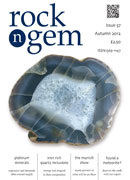
Rock n Gem Magazine Issue 57
Published Autumn 2012

Jewellery making from rock to pendant
Iron inclusions in quartz
in-depth article on Platinum minerals
Have you found a meteorite?
healing stones - W
Fossil, gemstone & general news, crystal shop & website directories, listings
gemstone market reports issue 62
There has been a resurgence in the popularity of pink gemstones, in part due to the ever expanding Chinese marker. The high price of pink sapphire has meant that other gems have also been in demand such as Morganite (pink Beryl) and Kunzite. The availability of top quality Sri Lankan pink sapphire has decreased as has fine material from Madagascar;
Meteorites and Meteor Showers
By David Bryant
Every year in mid-August astronomers all over the world eagerly anticipate the Perseid Meteor Shower: some years the sky can be full of ‘shooting stars’, on others hardly a handful are seen.
This year was pretty good: I personally observed over sixty meteors in around two hours and even managed to photograph one as it passed close to the familiar ‘W’ shaped constellation, Cassiopeia:
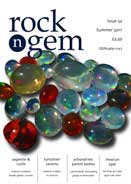
Rock n Gem Magazine Issue 56
Published Summer 2012

Rainbow Obsidian
Golden Goethite
in-depth article on Boron minerals
Libyan Desert Glass
healing stones - V
Fossil, gemstone & general news, crystal shop & website directories, listings
fossil news from issue 62
The installation of a natural gas pipeline in Enid, Oklahoma USA leads to the discovery of a mammoth fossil; researchers will now excavate and reconstruct the 50,000 year old fossil.
Fancy a pair of Duelling Dinosaurs to add to your collection? Well the Montana Duelling Dinosaurs first discovered in 2006 will be appearing at Bonham's auctions, one thought to be a plant eater similar to a triceratops the other a relative of tyrannosaurus.
letters issue 68
happy to receive letters, but email is quicker!
Dear Editor, Please forward to Barry Taylor.
Dear Barry Taylor,
Having been made aware of your agate interest by your letter to Ed., may I ask your advice on sourcing rough material
similar in colour to attached image. This is part of a 17thC German sword hilt so no doubt was originally found in Idar,
Any thoughts, please?
Sincerely, L W
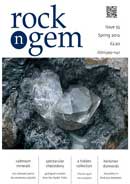
Rock n Gem Magazine Issue 55
Published Spring 2012

herkimer diamonds
sea scorpions
in-depth article on Cadmium minerals
spectacular chalcedony
healing stones - U
Fossil, gemstone & general news, crystal shop & website directories, listings
letters from issue 63
Dear Editor
For some time I have been considering the idea of gold digging in the UK, the recent US documentaries I have to admit are fuelling my ambition. I came across a gold prospecting map from a website and thought it may be worth a try. As I live in Scotland I tried there first not having to travel far. I went with the correct tools and enthusiasm to find that actually it is a long drawn out process and not very profitable (if I were in for a living). It did make me realise that all those years ago when our ancestors traipsed off abroad to make their fortunes, how hard it must have been, and in my case for what. I wanted to write to you not just to tell you my story but to highlight to any hopeful gold diggers out there that actually it is a good day out but don’t expect gold at the end of it, and whatever you do don’t spend a fortune on tools (I have learnt my lesson).
Thanks, Rock n Gem
Tom. A (recreational) Gold Digger
(Ed. Shhh..we’re also fans of a little gold, gem & fossil prospecting, but please make sure you adhere to rules and regulations when it comes to ‘collecting, perhaps some of the readily publicised locations are where gold used to be!)
cover of issue 68
South Australia Museum opal exhibition, including the exhibition’s centerpiece, the Virgin Rainbow, is itself worth in excess of a million dollars and its refracting colours defy description.
We had to put the picture of the renown ‘Virgin Rainbow’ opal on this issue’s cover because it’s simply stunning.
It’s some distance for a lot of our readers but if you happen to have the opportunity to visit the South Australian Museum in Adelaide you’ll sure to be impressed with the superb collection of opals on view.(exibition closes spring 2016)
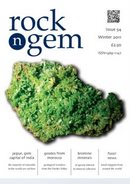
Rock n Gem Magazine Issue 54
Published Winter 2011

Gem capital of India Jaipur
in-depth article on Bromine minerals
moldavite
geodes from Morroco
healing stones - T
Fossil, gemstone & general news, crystal shop & website directories, listings
negotiations in munich 12 member of SMLS on tour
12 members of the Sussex Mineral and Lapidary Society spent a week during April 2013 collecting minerals in Morocco
One of the most amazing collecting locations we visited was the Tizi n Inouzane pass high up in the High Atlas mountains (Fig. 1). The minerals we collected included intense yellow hexagonal prismatic crystals of apatite from the pegmatite veins just below the snow line. I collected around a dozen nice 1 cm crystals, but I did not manage to collect any apatite on matrix.
sulphur minerals
By John Betterton
Sulfur, S, occurs at about 260 ppm in the Earth’s crust and its various minerals are very diverse and some are abundant.
World production currently stands at exceeds 70,000,000 tonnes per year. Most of it is recovered from fossil fuels from leading nations such as the USA, Canada, Russia, China, Saudi Arabia etc.
The industrial uses for sulfur are vast and range from vulcanisation of rubber, sulphuric acid, sulfur trioxide, numerous other chemical and pharmaceutical compounds, fertilizers, rust removal, explosives, fuels, paints, bleach papers, detergents, many organic compounds etc.
Rock n Gem Magazine Issue 53
Published Autumn 2011

fossils of the Whitby Coast with Dean Lomax
a demonstration of cutting and polishing amber
achondrite meteorites
slab saw exploits
healing stones - S
Fossil, gemstone & general news, crystal shop & website directories, listings
What is Metal Clay?
Tracey Spurgin
Metal Clay Artist and tutor
What is Metal Clay?
Silver clay was the first metal clay to venture onto the market.
It is silver that is reclaimed from industrial processes such as the film and medical industries. Using various lengthy processes to reclaim the silver, it is ground to a fine powder mixed with an organic binder and water.
basic origami techniques - silver clay
To Contact Tracey : Email:This email address is being protected from spambots. You need JavaScript enabled to view it. Website:www.craftworx.co.ukTel: 07961 883115
Silver clay is an amazing material not only does it come in a lump clay form, paste and syringe there is also a product called PMC
sheet. It behaves much like a piece of paper or fabric in this simple project Tracey uses basic origami techniques to make an effective design.
Rock n Gem Magazine Issue 52
Published Summer 2011

mexican opal
chondrites, lapidary saw woes
thallium minerals
jewellery making, adventures
Fossil, gemstone & general news, crystal shop & website directories, listings
earths crustal evolution food for thought
An article in a recent issue of the New Scientist Magazine caught my eye it has referred to a paper written by Tilman Spohn of the Institute of Planetary Research in Berlin and was published on 23rd November 2013.
The Article is about the crustal evolution of our planet Earth, whilst this article is recorded as just a thought process, much about this theory when carefully considered rings true.
Crystal Prescriptions Crystal Solutions To Electromagnetic Pollution And Geopathic Stress An A-Z Guide
Volume 3, by Judy Hall, pages 270 rrp £8.99
After the previous A-Z guides from this renown Keen to peep at this new book from Judy Hall I tore open the envelope and quickly flicked through the pages and noticed it was packed full of text, a lot information, but not a glossy crystal
picture in sight.
Rock n Gem Magazine Issue 51
Published Spring 2011

dinosaur bone
meteorites, lapidary woes
germanium minerals
jewellery art and design concepts
Fossil, gemstone & general news, directories, listings
how to create custom mineral stands
a feature article
For some time I’d had a problem. A problem which became greater as my mineral collection grew. A problem with which, I suspect, other readers may be familiar; how best to display specimens in the limited space available. Often their centres of gravity are such that...
The Angels & Gemstone Guardians Cards
by Margaret Ann Lembo
Mind Body Spirit shops are awash with card decks, often with comprehensive instructions for involved and sometimes complex layouts, 3 card, 5 card spreads and more.
However Margaret Ann Lembo based in Florida has provided something a little different, instructions are provided but just to shuffle, pick, connect to the gemstone by gazing upon it’s image, then read the text. Which is a combination of identifying
why you selected that gemstone and a message provided to guide you to work with it.
About the magazine
This once quarterly publication encompasses a wide range of topics all relating to minerals whether untouched, faceted, carved, shaped, polished, fossilised, set in jewellery or beads. We have articles including how to: find your minerals, create a jewellery masterpiece by setting your favourite mineral in precious metal or stringing mineral beads to form a unique necklace. prepare your stone by cutting, faceting and polishing with the art of lapidary crystal healing properties and uses of crystals and minerals within ancient and modern times. As long as there's a rock we'll talk about it!
no heat required
If there's a creative young person in the house, or you fancy making unique gifts on a budget here's an ideal way to nurture that creativity and develop an interest.
The cost of setting up a hobby can be prohibitive especially where working with precious metals is concerned, I favour the start slow approach buying tools as needed.
I have seen people spend an awful lot of money only to see their custom built workshop and hundreds of pounds worth of tools gradually collect dust...
Rummaging through oddment boxes in shops or at shows you can often find cheap beads, broken strings or even be able to purchase larger beads singularly.
The trick here is a bead already drilled. Failing that if you have a favourite tumblestone find someone to drill a hole for you, you may find someone at a local shop or craft event that can help with this.
What you'll need is some silver head pins at least 1.5 times as long as your bead, we found some tumbled Lapis lazuli drilled with a 2mm hole. Fancy silver beads if you want to add some decoration to the finished design.
Finally a silver ring of some type to thread your chain, cord, ribbon or whatever material you have chosen to hang the piece from.
The only real tool you will require is a pair of pliers, ideally round nose but you could adapt our method and use standard pliers.
We threaded the decorative bead onto the head pin followed by the beads then a second decorative bead.
Make sure the beads are held tightly together then grasp the end of the pin close to the top bead with the pliers and bend the pin around a jaw o the pliers to create a hoop, we wrapped it around twice.
We had a selection of fixings, jump-ring, snap bail, D shaped wire jump-ring, but you could also use triangular bails, or small split rings, just remember that with jumprings use a thick wire because you won't be soldering the joint and you want it to be strong enough to withstand daily wear.
You may have a little extra wire of the pin to deal with either cut it off or wrap around the hoop you have just formed.
Open the jump-ring (or fixing) put through the hoop and close, for our demonstration we chose a sturdy thick jump-ring.
snippets - black tourmaline in industry
Powdered tourmaline as an ingredient to ceramic water/air purifyers, showers, swimming pools and fridges.
Tourmaline comprises of several different elements including aluminium, boron, iron, lithium, magnesium and manganese. It has...
Minerals
The magazine has regular featured mineral article most issues, everything from creation, abundance to crystal lattice and structure.
Rocks, stones crystals, gems all formed from minerals or the combination of, made up of atoms and electrons and formed with distinctive characteristics, shapes and structures.
Often formed by volcanic activity, magma, compression and evaporation of water.
Several known structures are seen including cubic, tetragonal,hexagonal,monoclinic, triclinic, orthorhombic.
The magazine always has a range of suppliers that stock minerals both common and hard to find.
Excerpt from report on tin minerals in issue 40
gemstone market report issue 65
market report
a regular feature provided by
RM Weare & Co
Mozambique ruby has made a big impact on the market. Unheated material is now in abundance with plenty of really fine material available For many buyers the Burmese material has taken a back seat. For the Chinese market especially, the Mozambique material is preferable as there is much mistrust of anything that has been “treated” – even if just heat treated as is the case with much of the Burmese material.
cover of issue 67
Our cover picture courtesy of NASA Earth Observatory Landsat 8 satellite, shows a portion of the Tien Shan mountain range in the north western Xinjiang province China.
Formed some 300 million years ago when part of Australia collided with Eurasia, along with a chain of volcanic activity approximately 50 million years later.
The image shows a classic thrust fault caused when pressure forces horizontal sedimentary rock into up and down folds.
Gemstones
The magazine has a regular gemstone report provided by an industry insider, news on the latest availability, whats good and not so good and what to look out for.Don't forget we also have Gemologists that also submit articles for the magazine. If you have researched a particular gem and would like to share your knowledge please get in touch.
Gemstone is the name given to rarer high quality(good colour & clarity) mineral which has been cut into a certain shape ie baguette, princess, cabochon, facet ideally to be set into a piece of jewellery.
Other crystals, stones are sometimes also referred to as gems but they may be created from a combination of
minerals.Precious and semi-precious are also terms relating to gemstones, however mostly over used by the commercial market.
Normally if the gem is colourful enough and sufficiently rare it will be more highly prized and valued.
The magazine always has a range of suppliers that stock a comprehensive range of gems and gemstones.
Gemstone news report excerpt from issue 42
fossil news issue 65
fossil news
a collection of fossil snippets from around the world
a regular feature
A study of ancient mammal relatives called synapsids has discovered that the creatures developed nocturnal activities probably 100 million years early than once thought. Finding and examining fossils from 315 - 200 million years ago researchers focused on scleral ossicles the tiny bones involved with eyesight. Even the infamous Dimetrodon is now thought to have been a night stalker.
tips for choosing stones
There are many reasons for you to make that ‘stone’ purchase, whether for collecting, being captivated, business, magical or spur of a moment, but if you’re hunting for a specific stone is it the one shinning brighter standing out from the rest?
Or will you be applying some trusted techniques to evaluate your purchases. Whilst gem professionals have studied to evaluate stones and are confident when purchasing, everyday folk can only go by their own experience and that of more learned friends, often prospective purchasers can be seen referring potential purchases to their friends for approval. But perhaps you’ve ventured out alone or want to be confident in your own decision making.
Fossils
The magazine contains a regular fossil report, provided by an expert in the field, the latest news from the fossil is included every quarter, don't forget we'll always welcome your contributions as well!
Fossils originate from the remains of animals, plants, matter and creatures alive many thousands and millions of years ago.
The organic matter or tissue slowly becomes replaced by mineral stone and crystal.
the moonstone
the moonstone
by Ruby Loveridge
...believed to be drops from the moon itself, only frozen in the form of a stone
The Moonstone is part of the very large mineral group, Feldspar; which comprise of almost two thirds of the Earths’ rocks. The Moonstone is actually known as ‘adularia’, a potassium aluminosilicate of gemstone quality, which is commonly found near the Adula Group in the European Alps - hence the name ‘adularia’. Though typically colorless, the Moonstone however can range from a vast amount of colors such as gray, yellow, pink and white.
Gem Market Report Issue 67
a regular feature provided by RM Weare & Co
The February and March gem shows were disappointing for cutters, the Chinese presence was low (partly due to the Chinese New Year
and it’s subdued market.
Jewellery Making
An art with roots dating back to the beginning of man!
Most commonly associated with precious metals such as gold, silver, platinum and gemstones but gaining in popularity using a range of materials from gemstones, mineral beads, metals to resins, glass, leather and really any material either natural or man made.
The magazine runs articles on aspects of jewellery making with precious, semi precious gemstones and natural crystals and minerals, we are cover the popular pursuit of bead making as well.
We take about tools and methods from traditional to modern day with the latest technology.
The magazine always has a comprehensive range of suppliers advertising the necessary components, tools, gemstones and beads.
Excerpt Jewellery making article from issue 44
Excerpt bead jewellery making from issue 45
planetary craters
planetary craters:
what made all those holes? Part 2
By David Bryant
In 1908 a massive explosion laid waste to thirty square miles of Siberian pine forest near the Tungus River. Thousands of trees were felled around an obvious epicentre and many animals (and quite probably local tribesmen) were incinerated or killed by the blast. Strange night-glows in the sky persisted for several days, while witnesses reported a blinding light and shattering concussion. However, despite numerous expeditions to the region, no satisfactory explanation has been forthcoming.
A 2014 TV documentary followed the adventures of a group of international scientists as they investigated the Tunguska impact site in Siberia: each one had a pet theory:
zeolites and associated minerals part 2
Stilbite and Heulandite by Barry Taylor
Stilbite
This beautiful Zeolite is also known as Wheat Sheaf Ore due to its distinctive crystal shape when twinned, looking like the stooks of wheat,
fresh in the fields when hand gathered. Stlibite is commonly found ...
Buy the Rock n Gem magazine
Copies are limited in availability and may become out of stock at any time so act now, click to view details and buy!
lapis lazuli a gem with history
Lapis Lazuli, commonly known as lapis. It was much prized and reverred by the people of the world’s first civilizations in Mesopotamia, Egypt, and the Indus Valley. Also, much prized by the ancient Greeks, Persian’s and Romans. In very ancient times it was known as Sapphire, a name now of course given...
zeolites and associated minerals part 1
This very attractive mineral can often look similar to crystals of quartz, the crystals are found in association with Zeolites which are a confusing group that I will be looking at in detail later. Crystals of Apophyllite ...
Magazine
In print since the 90's the magazine continues to grow encompassing the many aspects and pursuits relating to the earths treasures.
To puchase any of the Rock 'n' magazine back issues, to see features and topics covered in previous magazines.
indium minerals
By John Betterton
The metal indium, In, is a very rare element with an average crustal abundance of about 0.1 ppm. World production stands at around 600 tonnes per year with China, Canada, Japan and South Korea the main producers
The metal indium, In, is a very rare element
Ice from Above!
By David Bryant
A recent TV documentary (of the somewhat over-dramatic variety!) sought to explain several recent – and very damaging - falls of ice. Arriving at high speed from cloudless skies, these have battered roofs, cars and aircraft. The conclusion of the program was that these were examples of ‘mega-hailstones’, poorly-understood phenomena, more usually called megacryometeors by the Scientific community.
Rock n Gem Magazine Issue 50
Published Winter 2010

flow patterns and structures in agate
the most ancient and pristine meteorites group
caaesium minerals
jewellery art and design
Fossil, gemstone & general news, directories, listings
Raden Technique Resin Earrings
by Tracey Spurgin of craftworx.co.uk
The Raden technique is an ancient skill from Japan that takes wafer thin slivers of mother of pearl shell and embeds it into resin to add an iridescent shimmer and sparkle.
Tracey delivers a full programme of silver clay workshops from her own studio in Yorkshire but travels far and wide to other venues such as colleges, galleries and art centres, to deliver a range of workshops that appeal to the complete beginner as well as the progressing enthusiast.
pyrite or fools gold
Pyrite is a wonderful common mineral, it is composed of Iron Fe and Sulphur S with the chemical formula of FeS2.
Rock n Gem Magazine Issue 49
Published Autumn 2010
rock n gem magazine 49
Ocean Jasper shortage?
Meteorites & Ethics
Lapis Lazuli in depth
Opal Hunting at Coober Pedy
Fossil, gemstone & general news, directories, listings
moon rock mysteries
by David Bryant
Until July, 1969 the idea that genuine fragments of rock from the Moon would one day be available for scientific research would have seemed highly unlikely: the possibility that such material could be added at relatively low cost to an amateur collection would not have even been considered. Fifty years later, anyone can purchase a genuine (if tiny!) piece of lunar rock for as little as £20: several hundred kilos of such material is available online and from dealers (Caveat emptor! Not all ‘moon rocks’ on internet auction sites are genuine:
fossil news issue 66
a collection of fossil snippets from around the world
Recent skeleton studies from the 17th-18th century in Warsaw Poland suggest that six bodies were buried with stones under their chins and sickles across their bodies, folklore traced to the 11th century says that this is a preventative measure because the first person(s) to die from a disease were likely to become a vampire and this would prevent them from biting the living. Health research of the area suggests that this was a time of repeated cholera epidemics in the region and a lack of understanding resulted in the community turning to supernatural explanations & preventions.
Rock n Gem Magazine Issue 48
Published Summer 2010
Spectacular Jaspers, including lepardskin, rainforest, onwhee
The world of ammolites
Planetary Meteorites
Gems in Ayurveda - Rasa Shastra
Mexican Red Amber
Obsidian art
Lapidary, creating your own cabbing machine
news, directories, listings
Subcategories
Content
reviews
reviews from editors and contributors of books, tools equipment, classes, events.
jewellery making
jewellery making tips, tricks an ideas.
crystal healing
Articles on crystal healing, using stones for well-being.
letters
letters from readers and visitors of the magazine and website
To see a list of mineral, crystal, gemstone, fossil shows/events both UK and worldwide visit our show page, if you organise or know of a show please get in touch to list it here.